Saturday, May 19, 2007

Simone Weil

I am reading a biography of Simone Weil, a French philosopher of the early twentieth century. Weil was a women from a privileged secular Jewish family who had extraordinary intellectual gifts and devoted her short life to understanding poverty and affliction. She worked as a teacher and volunteered her time in the evening to giving lectures to workers and promoting trade unions. She spent several years on and off in hard physical labour, something for which she was particularly unsuited. She had immense difficulty with fine motor control, and only acquired legible handwriting as a child through prolonged effort. She also suffered paralysing migraines.

Weil was driven by her desire for social justice. She moved from a position of strict pacifism to action, and participated in the Spanish civil war and the French resistance. She converted to Christianity and in her later writing expressed the plight of the worker as "affliction" rather than "oppression". She died of tuberculosis in 1942 at the age of 34. She had restricted her food intake out of sympathy for those in occupied France.

Oppression and Liberty , her first significant work, made a tremendous impact on me when I read it years ago; more recently I read The Need for Roots, her last work. Notes from her lectures on philosophy were later published and are still used today as a university philosophy text.

In Waiting for God she wrote about human relationships,

    He who treats as equals those who are far below him in strength really makes them a gift of the quality of human beings ... As far as it is possible for a creature, he reproduces the original generosity of the Creator. ... The supernatural virtue of justice consists of behaving exactly as though there were equality when one is the stronger in an unequal relationship.
And on faith and religion,

    We must have given all our attention, all our faith, all our love to a particular religion in order to think of any other religion with the high degree of attention, faith and love that is proper to it.
She said,
    when from the depth
    of our being,
    we need, we seek a sound

    which does mean
    something: when we cry out
    for an answer

    and it is not granted, then,
    we touch the silence of God---

    Some begin to talk,
    to themselves, as do the mad;
    some give

    their hearts to silence.
from Stephanie Strickland. The Red Virgin.

    Russ Moore and Rosie the Riveter

    Sometimes, too often, I sneak a peak at the conservative blogs, the patriarchal blogs, and sometimes I just do a double take. I blink, I wrinkle my forehead and I ask why I am struck with profound dissonance. Take this. Here is a post by Russ Moore on Evangelical Same-Sex Marriages. Apparently he has taken it into his head that egalitarian marriages are "same sex" marriages. Bizarre. Why are these guys out to throw scorn on an egalitarian relationship? As if a man should be ashamed to treat a woman as an equal.


    But even more bizarre is the fact that this illustration was posted with his post. This image was in the original post, here, scroll down to May 1, 2007, but does not show up in the link to the full post here . However, there she is, Rosie the Riveter, who more appropriately serves as an icon on this site , which has the following goal.
                To recognize and preserve
                the history and legacy of working women,
                including volunteer women, during World War II;
                to promote cooperation and fellowship
                among such members and their descendants;
                and to further the advancement of patriotic ideals,
                excellence in the work place,
                and loyalty to the United States of America.

              Is there something here that Russ Moore is against - patriotism, volunteerism, excellence in the workplace? Probably not. It is just the image of a strong woman that these men - Stinson, Dever, Mahaney, and Moore, cannot abide. They don't want women who can stand on their own, and provide for and protect, and particpate and support others with their strength. God help us.

              Oh right, I forgot, they don't want women in the workplace, because, you know, if there is a war, women should just stay home - in the house and not participate, not build weapons, not test fly airplanes, not keep industry moving. Especially a widow like Rosie the Riveter has no business in the workplace.

              I am uneasy knowing that there is another image conference this weekend.

              Sunday, April 29, 2007

              "Word for word"

              Yesterday I finished my post with this quote and implied that I did not agree with it.

                The application may be right from the text, but it is not applications or ideas that are inspired. It is words.
              And I don't agree with it. Here is why. First, Jesus and the writers of the Christian scriptures quoted the Hebrew scriptures in a way that can be called eclectic and paraphrastic. Not word for word. Here is the article that I am planning to write about some time on the BBB. Which Old Tesament did Jesus prefer and quote from? So why should we differ from what Jesus did?

              Next, what was the model of translation given to us. The Greek Septuagint, I would suppose. After all this time I would have thought that I would know that there is no "word for word" concordance between words in the Hebrew and words in the Greek. But I really thought that people who argued for "word for word" had something up their sleeve.

              Lately, I've been reading a few Psalms in the Greek and Latin and then checking a little on the Hebrew, just a word here and there. And finally I realised that there are 4 words for "man" "human being" in Hebrew and 2 in Greek, and there is no set pattern as to how to translate them. In fact, each Hebrew word is translated into Greek by both Greek words. So, that's it - no "word for word" translation there.

              Well, at least there might be the same number of words in Greek as in Hebrew, right? No, actually there seem to be twice as many words in the Greek Septuagint as there are in Hebrew. So, not "word for word" in that way, either.

              Eclectic, paraphrastic, good enough for Jesus, good enough for me. That's why I don't worry about Bibles being "word for word".

              Ruth Tucker

              About 15 years ago I read Women in the Maze by Ruth Tucker. It was one of about 5 books which I read at the time which supported women's equality in the church. I gave or lent out all of those books and only remember them when I come across a related story. This is what happened today.

              I discovered a new blog called Parchment and Pen and sat and read few posts. I then took a look at the contributors and saw Ruth Tucker's name in the sidebar. Ruth had been teaching at Calvin Theological Seminary in Grand Rapids until recently when she was forced to leave under very unpleasant circumstances. This story was publicized last summer and I read it at the time but did not have time to post about it.

              It is a detailed account of gender discrimination in the church and seminary and leads to other issues such as whether one should expose wrong-doing in the church. Her different sites and posts dealing with the issue of when to go public are thought-provoking and insightful.

              The wrong doing that most concerns me also relates to gender discrimination. However, the people most maligned are for the most part men. These are the translators of the TNIV Bible translation, which has been accused of creating a translation which allows God's image to be distorted. Or in the words of the executive director of the Council of Biblical Manhood and Womanhood, as reported on this blog,

                Christians should respond by purchasing Bibles that reflect an essentially literal translation. Will we read translations that reflect the most accurate depiction of God or will we read translations that provide room for His image to be distorted? The application may be right from the text, but it is not applications or ideas that are inspired. It is words.
              I guess this post has wondered a bit from one topic to another, but the issue of when and how to speak out is a tough one and deserves reflection.

              Sunday, April 15, 2007

              Reading Lolita in Tehran

              by Azar Nafisi. This is a recounting of a "lady professors" experiences in Iran through the 80's and 90's. As a professor of English literature she exposes her students to "decadent" western novels. Her passion for freedom of opinion and literary expression is contagious and I read every page in wonder that I did not value this much the books which were freely available to me.

              It is only when the freedom of choice is removed and thought and opinion are prescribed that one becomes sensitive to the value of reading as transformation.

              Here are her thoughts on wearing the veil,
                The issue was not so much the veil itself as freedom of choice. My grandmother had refused to leave the house for three months when she was forced to unveil. I would be similiarly adamant in my own refusal. Little did I know that I would soon be given the choice of either veiling or being jailed, flogged and perhaps killed if I disobeyed. page 152

                A stern ayatollah, a blind and improbable philosopher-king, had decided to impose his dream on a country and a people and to re-create us in his own myopic vision. So he had formulated an ideal of me as a Muslim woman, as a Muslim woman teacher, and wanted me to look, act and in short live according to that ideal. Laleh and I , in refusing to accept that ideal, were taking not a political stance but an existential one. No, I could tell Mr. Bahri, it was not that piece of cloth that I rejected, it was the transformation being imposed on me that made me look in the mirror and hate the stranger I had become. page 165

              Christian women also have the right not to be objects molded according to someone else's vision. Is there anything more revolting than the stereotype of "so-called" biblical men and women. When will we remember how Paul nurtured the younger Christians and Phoebe protected and provided for him?

              Saturday, April 14, 2007

              Speaking Out

              I recently read this post, To Speak or Not to Speak ? which mentioned R. Groothuis thoughts on speaking out.

                I recently re-read an article by Rebecca Groothuis where she categorizes people into 3 groups concerning biblical equality. She discourages conversation with people who are very vocally against what they term ‘worldly feminism’ and says it is most often a fruitless exercise to try to convince a person whose mind is made up.

                Those who hold to hierarchy but accept that Christians who have other views are also concerned for being true to the scriptures are good candidates for some discussion but here again, it seldom convinces them to change their view. The most profitable group to speak with are those who have genuine questions and are willing to discuss different ways of translating certain passages and are open to learning what we have to communicate.
              If I wonder why other women are not speaking out in the conservative blogosphere, I guess this post gives me a clue. For me, I feel that I am happy to write as long as it represents problem-solving for my own thinking. I am not simply repeating myself for the fun of it.

              I know it may look as if I am sometimes, but each time I tackle an issue I seek greater depth or competence in some way. I have been surprised at how rewarding it is to comb through footnotes, etc, trying to get at the core of someone else's thinking. If nothing else, it is an academic discipline that I feel sure will pay off when applied to other areas.

              It is interesting though that Jimmy Carter in Our Endangered Values: America's Moral Crisis, called for more women to speak out. He writes,

                Women are greatly abused in many countries in the world, and the alleviation of their plight is made less likely by the mandated subservience of women by Christian fundamentalists. What is especially disappointing to me is the docile acceptance by so many strong Christian women of their subjugation and restricted role. page 93
              So I speak out and wonder in what way I can impact on the condition of women in other countries and cultures. I remember recently Stephen Lewis, a Canadian politician, returned from Africa and was speaking on the radio about the condition of women in places in Africa he had visited. He started to cry and was unable to continue speaking for a few minutes.

              It is not only there but here, and not only women, but men and children, it is the lack of human rights and dignity anywhere that should call to us.

              This is in answer to a recent comment on my blog.

              Wednesday, April 11, 2007

              Between Two Worlds: "Why Is There No Respect for Motherhood? Why Does the West Not Value Its Women?"

              Between Two Worlds: "Why Is There No Respect for Motherhood? Why Does the West Not Value Its Women?"

              I live in a very mixed ethnic society. I have one student whose mother was murdered by her father-in-law; this mother is one of many women murdered routinely by family members in our city. I have another student who was whisked overseas to be married at the age of 14. I have seen other things I wish I had not.

              But I feel proud to know that a Vancouver beauty queen is heading up this campaign.

                This website was created to spread information about the 19-year old Iranian girl Nazanin Mahabad Fatehi, who was previously sentenced to death by hanging for killing a man who ambushed and tried to rape her. At the end of May, the Iranian head of Judiciary overturned her death sentence, and sent the case back to a lower court. Nazanin's re-trial ended on Jan 10 2007.
              Nazanin was released on Jan. 31 after three years of prison. In Iran girls are considered adults at the age of 9 and can be married off to old men or found guilty of immorality.

              So I was just bowled over to find out that the plight of one adult female in combat fatigues has influenced certain so-called Christian males to make common cause with the president of Iran. One adult woman decides to exercise her contitutional freedom and some people forget that 9 year old girls can be legally married and impregnated according to the laws of this regime.

              No wonder Catherine Booth makes more sense to me as a preacher and defender of women than this bunch of chumps who wish to set themselves up as models of male leadership.

              Sunday, April 08, 2007

              Susan Wise Bauer on Stackhouse.

              Here is an excellent review by Bauer on Finally Feminist by John Stackhouse. I recommend it to anyone who wishes to know more about his book.

              HT Jim Hamilton.

              I commented today on Jim Hamilton's post where he mentions Bauer's review of Stackhouse's book but Jim deleted me. I had been involved in a discussion on the original post by Bauer as well as some other blog threads on the topic so I was familiar with the discussion.

              I later received an email from Stackhouse, who wrote to commiserate with me on the sad treatment that some of us former Plymouth Brethren have suffered for expressing our so-called 'feminist' views! I include John's email as encouragement for myself and others as an example of Plymouth Brethren who extend their egalitarian views on church government to women. F. F. Bruce is another. God bless them both.
                Dear Sister Suzanne,

                We have not met, I don't think, although I have picked up clues that we almost have! I have come across a little correspondence you have had with members of the ****[a blog which shall go unmentioned] on-line.

                Wow. ..... Your composure in the face of attacks by ****& co I find frankly astonishing--a tremendous tribute to the grace of Christ and your submission to him. Bless you for this excellent example, that both convicts and encourages me.

                I hope we do meet someday,

                John

                ===
                John G. Stackhouse, Jr.,
                Ph.D.Sangwoo Youtong Chee Professor of Theology and Culture
                Regent College
              And yes we did later meet.

              The Places in Between

              by Rory Stewart

              I felt great sympathy with this man's mother before I finished the book. He did not get enough to eat, nor did the dog! A harrowing story of a lone walk across Afghanistan in 2002. But a engaging narrative with a perfect blend of contemporary characters, history, culture and landscape.

              And this is why I loved this book. He wrote these lines,

                As we ate, our host, Khalife Amir, played a tamboura lute made from a small, yellow plastic oil bottle, a table leg and two wooden awls. He fingered only the lower string. I had not heard music for a month. My days had passed in silences with flurries of thought in a landscape that changed slowly.
                Note by note the music brought a sense of time back to me. Each pause was charged with anticipation of the next note and the slow revelation of a tune. Khalife Amir measured silence, dividing each minute into a succession of clear notes from the string and then weaving time together again with his tenor voice.
              Here is the NY Times review.

              An interesting character mentioned in passing in this book was Nancy Dupree who wrote An Historical Guide to Afghanistan. I had not heard of her before. Another historic personnage who figured in this book was Babur.

              After reading this book the traveller knows that there is always somewhere to go to get away from the crowds.

              Saturday, April 07, 2007

              Catherine Booth Resources

              I have enjoyed rereading this biography of Catherine Booth, Catherine Booth — a Sketch by Colonel Mildred Duff , which was given to me by one of my sisters when I was a teenager. It is written in an easy style and I find is quite engaging.

              However, it does not compare with reading the actual writings of Catherine Booth. They are powerful and articulate. Some of her works here are sermons recorded in shorthand and edited by Booth and then published. I highly recommend reading some of her sermons and other writing.

              Here is a piece that I found particularly moving. In this short paragraph taken from The Iniquity of State Regulated Vice (1884) we get a glimpse of Catherine Booth as a mother (she had 8 children), as a preacher, as a social reformer and a women who was not afraid to confront parliament in a time when women did not have the right to vote. She knew what it meant to care for widows and orphans. In a A Speech Delivered at Exeter Hall, London, on February 6th, 1884,on the Iniquity of State Regulated Vice,
                I did not think we were so low as this--that one member should suggest that the age of these innocents should be heightened to 14, and that another suggested it should be not so high. Another that it should be reduced to 10, and oh! my God, pleaded that it was hard for a man--HARD--for a man!--having a charge brought against him, not to be able to plead the consent of a child like that.
                I would not tell what, but for the grace of God, I should feel like doing to the man who brought that argument to bear on my child. (Applause.) I have a sweet innocent little girl--many of you have also--of 14, as innocent as an infant of any such things--what, if a man should make an application of this doctrine to her. Well may the higher classes take such care of their little girls? Well may they be so careful never to let them go out without efficient protectors. But what is to become of the little girls of poor unprotected widows?

              I highly recommend these writings - they are as pertinent today as when they were written, is some cases sadly so.

              Female Ministry, Or, Woman's Right to Preach the Gospel (1859)

              Female Teaching: Or, The Rev. A.A. Rees versus Mrs. Palmer (1861)

              Godliness: Being Reports of a Series of Addresses Delivered At James's Hall, London, W., During 1881

              The Iniquity of State Regulated Vice (1884)

              Papers on Aggressive Christianity (1880)

              Papers on Practical Religion (1879)

              Popular Christianity: A Series of Lectures (1888) (2nd ed.)

              Sunday, April 01, 2007

              Laura Margolis

              I am watching Shanghai Ghetto about Jewish refugees from Germany in Shanghai during WWII. I have read more about the Russian Jewish community in Shanghai, but this is a detailed documentary with interviews from those who lived as children in the Shanghai ghetto.

              I decided that I had to check out more information about Laura Margolis who was featured in this film. She died in 1997 at the age of 93. Here is a bit about her life,

                Born in Istanbul, where her father was a doctor to the Sultan of Turkey. Ms. Margolis came to the United States with her family in 1907. She worked with Settlement House helping immigrants in Buffalo, N.Y. and for Jewish Social Services in Cleveland before becoming the first female field agent of the American Jewish Joint Distribution Committee in 1937.

                The JDC first sent her to Cuba to help refugees fleeing Europe who were not being permitted to come directly to the USA. She tried to find a port of entry for a ship, the St. Louis, carrying Jews, but it was forced to return to Europe. In 1939, she was sent to Shanghai, where tens of thousands of fleeing Jews found refuge.

                Ms. Margolis, at considerable personal risk to herself, saved the lives of some 4,000 Jewish refugees who, close to starvation, precariously survived in the Heime (camps) in the Shanghai ghetto.

              The White Countess is a drama that gives a more atmospheric notion of pre WWII Shanghai. I enjoyed it.

              Monday, March 26, 2007

              The abuses of slavery

              This is in reponse to a discussion in the comment section of the BBB that physical abuse is a distortion of an otherwise just relationship of headship and submission. I have heard the argument that it is not fair to judge a practise by its distortion.

              In my experience the psychological effects of submission outweigh by far the physical cruelty of abuse, however painful that may be. Teaching your fellow human that he or she is created by God for subordination is the true cruelty, not the physical act of enforcing submission.

              I was relieved to see this exact point being made in so many words by the controversial philospher Kwame Appiah. He writes,

                When I think about how the world of the Ashanti remains etched and scored by slavery, an odd question arises: What is it about slavery that makes it morally objectionable? European and American abolitionists in the 19th century tended to focus, reasonably enough, on its cruelty: on the horrors that began with capture and separation from one’s family, continued in the cramped and putrid quarters below the decks of the middle passage and went on in plantations ruled by the lash.

                William Wilberforce, the evangelist and Tory member of Parliament who was as responsible as anyone for the passage of the 1807 Abolition of the Slave Trade Act, was not an enthusiast for democracy when it came to expanding the franchise, and he railed against the “mad-headed professors of liberty and equality.”

                It was the torments of slavery’s victims that moved him so. (He was also a founding member of the Royal Society for the Prevention of Cruelty to Animals.) Once freed slaves had been properly Christianized, he believed, “they will sustain with patience the sufferings of their actual lot.” In the United States, abolitionists mainly shared his perspective, naturally emphasizing the abundant horrors of plantation slavery.

                Slavery’s more sophisticated defenders had a response. They agreed that cruelty was wrong, but, they maintained, these horrors were abuses of the slavery system, not inherent features of it.

                What if their paternalist fantasies had come true, and a world of kindly slave masters had developed? Would slavery be acceptable? Of course not. Even a well-treated slave is diminished by his status. As a social or legal institution, slavery has built into it a denial of the social basis of self-respect: it defines the slave as lower in status by denying that she could have personal aims worthy of consideration and rejecting the enslaved person’s right to manage his or her own affairs.

                When you’re a slave, someone else is in charge of your life. What keeps the wound from healing is that this subordination is something you inherited from your parents and will pass along to your children.NY Times March 18, 2007
              I can only thank this writer for articulating so well the problem of a headship - submission relationship. Maybe one day we will all understand better that the core teaching of the scriptures is found in Lev. 19:18, Matt. 22:39, Mark 12:31, Rom. 13:9, Gal. 5:14, James 2:8.
                Thou shalt love thy neighbour (thy next one) as thyself: I am the LORD.

                Sunday, March 25, 2007

                Ilse Fredrichsdorff

                It seems that I have reopened this blog. I don't have many aspirations for writing here, but I do wish to use this space to keep track of some of the books and other material that I am reading.

                Today I remembered that I wanted to have a record of this post by Michael Bird.

                  Who the heck is Ilse Fredrichsdorff?In reading over Robert Yarbrough's excellent book, The Salvation-Historical Fallacy (p. 342, n. 9) he gives this quote from the preface of M. Albertz, Die Botschaft des Neuen Testament (1947-57) which left me gob-smacked:

                    "This book is dedicated to the young brethren of the Confessing Church. I was united with them in my office as leader of the Office of Theological Examination of the Confessing Church in Berlin-Brandenburg. I was all the closer to these brethren, whose status was illegal from the start, in that perforamnce of my ministry resulted in the loss of my freedom as well as my ordination, withdrawn by a bogus ecclesiastical authority. This book's dedication bears two names [one is Erich Klapproth, the other is] Ilse Fredrichsdorff ... When the church struggle began she was a young girl belonging to the Confessing Church congregation Nicolai-Melanchthon in Spandau. Through our congregation she came to take up theological study. She studied in our theological college and in Basel with Karl Barth. She became curate of the only truly evangelical confessional school that could be established under the Third Reich, the school for non-Aryan Christian children who were no longer permitted to attend the public school. During the war she reamined in congregations northeast of Berlin, in that region where the last battle prior to Berlin was waged. She was so much in demand for her pastoral skills that the major of the troop emplacements behind which lay the villages she served repeatedly requested her aid among the troops. Later she led the displaced congregations with the word of God, went back to the hunger zone as much as possible, and, after she had buried hundreds of the thousands who perished, succumbed herself to starvation (II/1, 13-14)."

                Saturday, March 24, 2007

                Catherine Booth: Adaption of measures

                I found this afternoon a book of sermons called Aggressive Christianity by Catherine Booth. These sermons were taken down in shorthand and appear in the book as she preached them.

                This one, Adaption of Measures relates well to a post I recently published on the BBB.

                  People contend that we must have quiet, proper, decorous services. I say, WHERE IS YOUR AUTHORITY FOR THIS? Not here. I defy any man to show it. I have a great deal more authority in this book for such a lively, gushing, spontaneous, and what you call disorderly, service, as our Army services sometimes are, in this 14th of Corinthians than you can find for yours.
                    The best insight we get into the internal working of a religious sevice in Apostolic times is in this chapter, and I ask you - is it anything like the ordinary services of to-day? Can the utmost stretch of ingenuity make it into anything like them? But even that is not complete. We cannot get the order of a single service from the New Testament, not can we get the form of government of a single church.

                    Hence one denomination think theirs is the best form, and another theirs; so Christendom has been divided into so many camps ever since; but this very quarelling shows the impossibility of getting from the New Testament the routine, the order, and the fashion of mere modes. They cannot get it, because it is not there!!

                    Do you think God had no purpose in this omission? The form, modes, and measures are not laid down as in the Old Testament dispensation. There is nothing of this stereotyped routinism in the whole of the New Testament. Why? Now there may be some who may have difficulties in this matter.
                    I said to a gentleman, who came to me with this and that difficulty about our modes and measures,
                      I will meet your difficulties by bringing them face to face with the bare principles of the New Testament. If I cannot substantiate and defend them by that I will give them up for ever. I am not wedded to any forms and measures.

                      To many of them I have been driven by the necessities of the case. God has driven me to them as at the point of the bayonet, as well as led me by the pillar of cloud, and when I have brought my reluctance and all my own conventional notions, in which I was brought up like other people, face to face with the naked bare principles of the New Testament, I have not found anything to stand upon! I find things here far more extravagant and extreme, than anything we do, looked at carefully
                    Here is the principle laid down that you are to adapt your measures to the necessity of the people to whom you minister: you are to take the Gospel to them in such modes and habitudes of thought and expression and circumstances, as will gain for it from them a HEARING. You are to speak in other tongues - go and preach it to them in such a way as they will look at it and listen to it! Oh! In that lesson we read what beautiful freedom from all set form and formula there was!

                  Tuesday, March 20, 2007

                  Combining Diacritics vs Precomposed Greek

                  Well, here I am back at combining diacritics. I may have to change the title of this blog to Suzanne's doodlepad. This is probably not a post of general interest.

                  To keep a long story short, most polytonic Greek is posted in precomposed form and displays well in IE7. But sometimes Greek text has been produced using combining diacritics. It is a pain because that makes two standards and you can't tell with the naked eye which is which. At least if they display properly you shouldn't be able to. But you can see in the first image how they both look in IE7.

                  The second image shows both kinds of text in their correct display form in New Athena Unicode and they should look identical.(Are you bored yet?)

                  The third image is of the two kinds of text displayed by individual glyph.You can see that the combining diacritics text has the ability to decompose, the other kind does not.

                  There are many pros and cons to all this, but I believe that the usual way to display Greek is by precomposed text. This is the opposite to Hebrew.

                  As far as Polytonic Greek is concerned, the best resource is Rodney Decker's resources. This page will take you from the age of the dinosaurs up to the present, so I would recommend starting to read this paper on page 10 or 11. The relevant stuff is on pages 14 and 15. Read point 4.3.3 and on footnote 3 on page 15. In fact, if you have to decide in any paper which part to read, I would recommend the footnotes.

                  In short, most polytonic Greek text is produced in precomposed text. Zhubert produces precomposed as well, so no problem. This is what the MS Greek keyboard does too and probably most of the others. But sometimes there is a bit of the combining diacritics stuff around. For some reason IE does not handle this well, although Firefox, as usual, has no problem. Go figure. BTW, here is a MAC biblioblog.

                  Anyway, IE7 now does font substitution like Firefox so fonts are not the problem - codepoints are. I use Babelpad to look at things like this along with Babelmap, from Babelstone, along with reading Babelstone Blog, which is a pretty cool blog about Unicode. Except that Andrew is writing about the Morrison Collection right now, so you have to check his archives.
                  Note: This post has been edited with new images.

                  Thursday, July 20, 2006

                  Posting a link

                  How to post a link in the comment section.

                  <a href="http://englishbibles.blogspot.com/">BBB</a>

                  becomes the following when posted.

                  BBB

                  I have created the first row of code using escape sequences so it doesn't automatically become a link. The second link is made by copying and posting the first sequence. Clear as mud, right. Try it.

                  Tuesday, July 04, 2006

                  Personal Post

                  I have posted tonight on the Better Bibles Blog on a personal matter.

                  Wednesday, June 21, 2006

                  Recent Posting

                  No. I have not actually gone away. I have been posting on the Better Bibles Blog. I have recently posted twice about 1 Tim. 2:15, here and here. I am also doing some offblog writing about one of my students. I had wanted to write about myself for a while here to develop a writing style so that I could write about some of the children that I work with better. It is paying off. I am sorry I cannot post my other writing now.

                  You would never guess from the fierceness of my 'Not saved by childbearing posts' that I am totally surrounded by children at school and at home every day. I visited a blog today that took me back some 15 years to the days when my own little guy played with Thomas the Tank Engine. Oh my goodness!

                  You never see me here on the blog playing with railroad track, and model planes, and dollsclothes, and my beloved dollshouse, with all the little sylvan critters with their little handknit sweaters and hats. Maybe next Christmas!

                  If there is any woman who loves the domestic domain it is me. But all the things I love are just that, my affections, and my affectations - they will not save me.

                  Wednesday, June 14, 2006

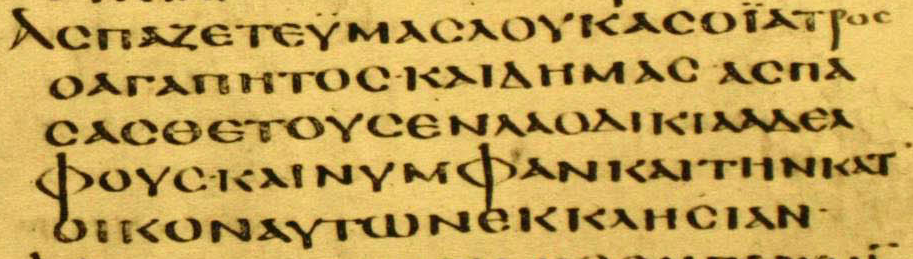
                  Codex Alexandrinus


                  "Our dear friend Luke, the doctor, and Demas send greetings, Give my greetings to the brothers and sisters at Laodicea, and to Nympha and the church in her house." Colossians 4:14-15

                  The Codex Alexandrinus (London, British Library, MS Royal 1. D. V-VIII) is a 5th century manuscript of the Greek Bible, containing the majority of the Septuagint and the New Testament. Along with the Codex Sinaiticus and the Codex Vaticanus, it is one of the earliest and most complete manuscripts of the Bible. It derives its name from Alexandria where it is believed to have been made.


                  Sunday, June 11, 2006

                  Deep Magic

                  Exploring the writings of contemporary theologians on atonement, I came across articles by Edith Humphrey. She is from Montreal and taught for several years at Augustine College in Ottawa.

                  Here is a sample of her writing on atonement.

                    When we try to ask questions about the necessity of the cross, about the necessity that the God-Man should die for us, words fail. Immediately as we say this, we remember that in the garden, Jesus had a choice, and that is what makes this act all the more wonderful. Rev. 5 speaks of the Lamb, the one who is given as Saviour and Spouse to God’s people, slain from the foundation of the earth.

                    We are, to use the words of C. S. Lewis, in the realm of “deep magic”, “magic from the dawn of time.” Perhaps, shrinking from the numerous ways that this part of the story is told in the Scriptures, we want to ask, “Why wouldn’t the righteous, perfect life of the Last Adam be enough to effect reconciliation?” Many answers have been given to that, including the importance of God’s justice, and the like.

                    We may want to speculate, along with a few of our elder brothers and sisters in the Church, that the incarnation might have been sufficient for God to share with us his glory, but because of the fall, the depth of human experience, crucifixion, death, and the utter descent, abandonment, had also to be plumbed. Or, to change the metaphor, the wages of sin is death; Or, to change the metaphor, the Lamb must be a slaughtered as well as a standing victorious Lamb.

                    Sometimes contemporary theologians point to the multiplicity of images in Scriptures for this great mystery in order to relativise, or to avoid the pictures that they find uncomfortable. What a desolation! The effect of the pictures is to point to a truth that is deeper, not less disturbing or challenging than the stories we currently shy away from -- the atonement was more costly, not less, than a earthly sacrifice; the battle was more intense, not less, than a human conflict; the journey was more arduous, not less, than the toughest human exploration; the price paid was beyond all human reasoning.

                    -------------

                    In the end, we go back again and again to Scripture, and to the enacted event of Jesus’ life, death and resurrection, the Eucharist, to be nourished and to have formed in us the mind of Christ. There, we see hear Paul and the gospels insisting on the historicity of what has been done for us, of God’s actions for Israel and through Messiah Jesus for the world, and of the mystery of Victory over sin and Death through the life, death and resurrection of our Lord. There we see them also glorying in the far-reaching aspects of this victory, a victory so deep and intimate that, through the work of the Holy Spirit, it declares innocent but also changes the person, each person who is in Christ, so that “glimpsed” glory becomes increasing glory.

                    Both Paul in his letters, and John in his visions, bring together the different variations of the story, reminding us that we need all the pictures, all of them accentuated, each of the songs played with all the stops out, each story taken to its fullest climax, without being used to qualifying or nullify the another. In Romans 5:9-11, we hear these words:

                      "9 Since we have now been justified by his blood, how much more shall we be saved from God's wrath through him! 10For if, when we were God's enemies, we were reconciled to him through the death of his Son, how much more, having been reconciled, shall we be saved through his life! 11Not only is this so, but we also rejoice in God through our Lord Jesus Christ, through whom we have now received reconciliation."

                    Here Paul speaks of atonement as justification, as the effect of blood sacrifice, as the removal of God’s wrath, and as reconciliation. John, in his vision, shows to us the Lamb: the Lamb who is both Victim and Victor, the Lamb who Interprets the meaning of the world, opening the scroll of mystery, the Lamb who also Mystifies, showing things that are beyond our ken, the Lamb who makes his dwelling with us, and is to be our Spouse, and the Lamb who invites -- invites to the tree and water of life.

                  Note: That was a pretty short break. However, these are just things that I am reading, not part of the earlier story which was the first chapter of my blog. I guess I won't stop reading.