Wednesday, June 30, 2010

Reminders about the ESV

Since a discussion about gender language in Bible translations has cropped up here and here, let me provide a reminder of why the ESV is not a good Bible translation with regard to gender.

Here is a passage from the preface to the ESV,
    In the area of gender language, the goal of the ESV is to render literally what is in the original. For example, “anyone” replaces “any man” where there is no word corresponding to “man” in the original languages, and “people” rather than “men” is regularly used where the original languages refer to both men and women. But the words “man” and “men” are retained where a male meaning component is part of the original Greek or Hebrew. Likewise, the word “man” has been retained where the original text intends to convey a clear contrast between “God” on the one hand and “man” on the other hand, with “man” being used in the collective sense of the whole human race (see Luke 2:52).
In Greek there is one word for man, as a male, aner; and another word, anthropos, for a "human." Since in English we don't use the word "human" in normal discourse, when this word occurs for a single male, we translate it as "man." However, when this word occurs in the plural, we translate it as "people." So, in translating Greek, the plural of aner is translated as "men" and the plural of anthropos is translated as "people."

Let's look at these verses in the ESV,
    and what you have heard from me in the presence of many witnesses entrust to faithful men who will be able to teach others also. 2 Tim. 2:2

    “When he ascended on high he led a host of captives,
    and he gave gifts to men.” Eph. 4:8

    And Jesus said to them, "Follow me, and I will make you become fishers of men. Mark 1:17

    And I tell you, everyone who acknowledges me before men, the Son of Man also will acknowledge before the angels of God Luke 12:8

    In him was life, and the life was the light of men. John 1:4

    Therefore, as one trespass led to condemnation for all men, so one act of righteousness leads to justification and life for all men. Romans 5:18

    For there is one God, and there is one mediator between God and men, the man Christ Jesus, 1 Tim. 2:5

    For every high priest chosen from among men is appointed to act on behalf of men in relation to God, to offer gifts and sacrifices for sins. Hebreww 5:1

    For no prophecy was ever produced by the will of man, but men spoke from God as they were carried along by the Holy Spirit. 2 Peter 1:21
According to the preface of the ESV, these verses should have been translated using the word "people" in order to be literal, gender accurate and transparent to the Greek.

If the ESV used "men" instead of "people" in order to be traditional and to preserve euphony, then the translators had better say so. They would need to admit that the translation is not all that literal, not literal at all when it comes to gender, but traditional, conservative, and preserving the rhythm of the KJV.

What is so wrong with admitting this? Why do the translators claim for their translation something that is simply not true? It's a tissue of nonsense, a tangled web of half truths.

Why use a gender inclusive translation

Here is Daniel Kirk on the topic, HT Joel,
    To the overall question, why require a gender-inclusive translation? My overall answer is this: to keep transforming the culture of the church until we actually believe (and therefore act like) that women and men are equal members of the body of Christ, equally addressed by the word of God, and equally empowered by the Spirit to serve in it (and therefore lead it).

    My student asked specifically about requiring the now defunct TNIV and the NRSV that was sponsored by the World Council of Churches and has not been well received in evangelical circles.

    This is a crucial question. In my estimation the reason that these gender inclusive translations have not caught on in evangelicalism is precisely because conservative churches are theologically opposed to gender equality. It is because they are guarding against the sort of transformation that I think needs to take place that they choose to preserve and further language of masculine hegemony. In resisting even gender-inclusive language for humanity, however (e.g., not allowing adelphoi to be translated “brothers and sisters,” but instead insisting on “brothers”), the English translation expresses an exclusivity that was not there in the Greek. This is a case where “more literal” is not equivalent to “more accurate.”

    The final couple of questions from my student were along the lines of who cares? and why bother? Why not use “mankind” and “man” rather than human? In addition to what I’ve outlined above, the reason I care is that women who are learning to locate themselves, as women, in the world, need to be told and have reinforced from every angle that they do not have to become male (or approximate maleness) in order to fully realize their humanness, to become who God desires them to be as restored image-bearers of Christ.

    The church has been shackled by the idea that maleness is ontologically superior to femaleness. This has ramifications for how the church thinks about Jesus and how it thinks about gender among us humans.

    With respect to Jesus: the ESV gives some hints as to the necessity for certain people to hold onto Jesus’ maleness as a sine qua non of salvation. A translation that prides itself on rendering words consistently and accurately translates ἄνθρωποι as “people” in 1 Timothy 2:4, “…desires all people to be saved and to come to the knowledge of the truth.” With this desire for all people as the set-up, however, the ESV simply cannot bring itself to say that a human is a sufficient category for a savior. No, it has to be male: “For there is one God, and one mediator between God and men [!, ἄνθρωποι], the man [! ἄνθρωπος] Christ Jesus” (1 Timothy 2:5).

    We need to embrace gender-neutral terminology for humanity so that we can start to disentangle ourselves from skewed notions about maleness and salvation. And if you think I’m just making up the idea that the maleness of Jesus is an essential part of conservative evangelical theology, then maybe you can drop a note to Paternoster Press and ask why, after printing Neil Williams’ new book The Maleness of Jesus, they canceled the contract and are refusing to distribute it.

    Of course, as soon as being male is required to represent humanity before God, then being male is required to represent God before God’s people. The continuing deafness of the evangelical world to the biblical passages that give counter-testimony to 1 Timothy 3 from the early church is another lingering effect of gender-exclusive Bible translation. So long as we think that to be truly human is to be man, and so long as we think that a man must be the mediator between God and man, women will never be able to participate as full, co-equal partners.

    So yes, I care. And as a man I think it’s more important for me to champion this cause than it is for women to champion it themselves. Because the call of the gospel isn’t to spend all our time getting worked up over our own rights, but to spend all our time getting worked up over how life can come to the other.

Thanks very much, Daniel.

Wednesday, June 23, 2010

Just overworked

I don't expect to be blogging much for the next few weeks, and I haven't blogged much this year. However, I am not sick or depressed, nor am I a mirthless sourpuss feminist - just overworked. While I am absent, I will post my staff pic to keep you company.

(Well, I am a feminist - just not mirthless!)

Sunday, June 20, 2010

Clubbish

I read Ron Hendel's critique of the Society of Biblical Literature a few days ago. I have not attended SBL but I do follow its meetings with interest. I then read this response. I don't myself think that there should be any place at SBL for faith committments, as long as these include an attitude which subordinates, or denounces women, queers and any other natural class of human beings.

I particularly take exception to the ongoing critique of feminist and queer hermeneutics as being "clubbish." First, I have no doubt that some of it is unattractive. So here I wish to address what I have found to be "clubbish" among evangelicals, and why I would not go anywhere into any physical space where there is a danger of their attitudes about women being given voice.

I am acquainted with a very vocal and well-known SBL theologian of the evangelical leaning. I sat and listened to him lecture 200 young people on how the cause of contemporary divorce is that women will not accept their role. This was his interpretation of Gen. 3:16 and this view is widely held by evangelicals. He is an influential theologian.

I questioned him on this since I was in the process of divorcing because I had suffered ongoing violence, being controlled by being shut in my room, hit and sworn at, combined with having Bible verses used to condemn me to hell.

The theologian in question did have any interest in this situation, but he vociferously questioned my right to remarry. I had no interest in remarrying, I simply wanted to be safe.

I found his lecture, his commentary on Gen. and his response to a woman wanting a divorce for violence to be incrdibliy callous and yes even "clubbish." But he gets rave reviews by evangelicals for being so "reasonable" and open-minded.

Unless one has actually been beaten, as many women and queers have been, for reasons relating to being a woman or a queer, then I suggest that using the term "clubbish" for the hermenuetic of feminists and queeers is not appropriate.

The appeal of Christianity is that Christ actually experieced being beaten, he did not claim a privilege not open to women and queers.

However, Paul did claim a privilege not open to women, slaves, and non-Roman citizens. He asked, as a Roman citizen, not to be beaten.

That women have not had such a legal privilege until recently, that they may experience this for much of their life, that being beaten can be just a normal consequence of being a woman, is still to fresh in my mind.

Perhaps feminists and queers are clubbish, but [some] evangelical Christians are callous to the most outrageous suffering in their midst and should clean out their own stables first. I firmly believe that any space where people are free to express their faith commitments, in such a way as to denigrate even the tiniest bit, women, homosexuals, or those of another religion or race, is not an appropriate place for academic exchange.

Friday, June 18, 2010

Paul and Thecla

James McGrath links to a post about Paul and Thecla. There is an interesting tradition that Thecla's eyes and hands were erased because they were a sign of her authority.
    Bart Ehrman (if I remember correctly) shares a photo of the same fresco in one of his books, and points out that Thecla's "teaching hand" has been deliberately defaced (as have her eyes), by someone who found this depiction of her authority threatening. Crossan and Reed also make this point.

Thursday, June 17, 2010

hilarious

I don't usually laugh out loud at America pronunciation. I try to muffle my mirth if I can. Of course, I expect to be the source of a little mirth myself. But listen to this. HT Nick.

Huguenot

Huguenot


I had never heard the first one before, but I am of Huguenot stock myself so I am familiar with the first rendition in the second link. Give me a call and hear how I pronounce it! is there anyone out there with the Oxford pronunciation?

Tuesday, June 15, 2010

Because it matters

This blog, by Danni Moss, was one of the first blogs that I read in the Christian blogosphere. I just read today that the author has died of cancer. I am so grateful for her blog, and I hope that her influence will remain. Its a long journey out of violence as a way of life.

Monday, June 14, 2010

Not a slam dunk

There has been a discussion on Cheryl's blog, where a commenter is very sure that kephale, meaning "head," as in the object on top of your neck, is a slam dunk for "authority". He perhaps thinks this because he has read this entry.

"Definition
the head, both of men and often of animals. Since the loss of the head destroys life, this word is used in the phrases relating to capital and extreme punishment.
metaph. anything supreme, chief, prominent
of persons, master lord: of a husband in relation to his wife
of Christ: the Lord of the husband and of the Church
of things: the corner stone"

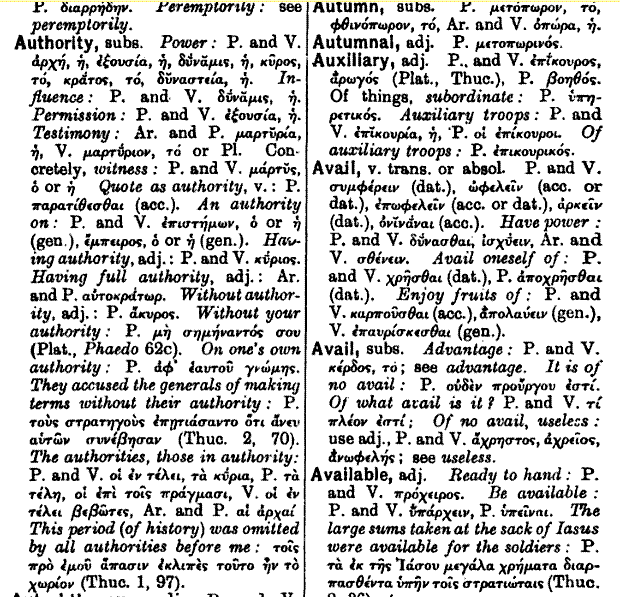
However, if you were to look in a dictionary of classical Greek, i.e. English-Greek dictionary: a vocabulary of the Attic language by S. C. Woodhouse, you would not see either kephale or authenteo, as equivalents for the English word "authority."

One may argue that this is because Hellenistic Greek was just that different. In fact, the main difference in the lexicons is that one dictionary is theologically motivated and the other is not. Lexicons of classical Greek routinely include meanings from Hellenistic Greek.

Kephale was not a Greek term for "master" or "lord" occuring in any context other than interpretations of verses in the New Testament itself. There is no outside confirmation of this use, except that the word kephale was used for Jephthah. This is an unusual use of the word in the Septuagint, and is rarely discussed. I would be interested in discussing why, of all leaders in the Greek Old Testament, only Jephthah was called kephale.

This is an interesting topic for discussion - but not a slam dunk. Someone needs to mention to me one other person besides Jephthah, outside of the New Testament (but preceding or at the same time as the NT) who was ever called the kephale of a person or group that he or she was in authority over.

Sunday, June 13, 2010

Passionately outspoken for Christian feminism

I have been reading too many critiques of feminism in the Christian blogosphere recently, as if it were to blame for anything one doesn't like. The premise seems to be that we have only had _______ since women have been declared equal under the law. Now fill in the blank with the economic crisis, earthquakes and oil spills. I would like to take credit for modern dentistry myself, but I forget how it is a consequence of feminism. Not that explanations are usually required.

According to Mary Kassian, a prominent Canadian Christian author and anti-feminist, "pornography, and rape and homosexuality and sexual perversion were uncommon and rarely encountered" in the 1960's, preceding the expansion of feminism. I personally thought all these vices were alive and well in Sodom and Gomorrah, where feminism doesn't seem to have had much traction.

In a blog comment on this post, Mary Kassian declares,
    I think feminism and Christianity are incompatible. Feminism can’t be “redeemed.” If you’re interested in finding out more about the history and philosophy of feminism, I suggest you read my book, “The Feminist Mistake.”
However, Alex, a brave commenter and Christian woman, responds to Mary Kassian at length and with passion about the proper attitude of Christian women towards feminism. Here is one of her later comments,
    We must remember that we owe a lot of our freedom today to the feminist of the past. The fact that you can write a book without using a male alias, the fact the we can get ‘equal pay for equal work’, the fact the rape is illegal in marriage, the fact the a women’s testimony is not worth less than a mans and many more freedoms have been won. Truly if you want to see the effects of feminism, look to the places without it. In places like Asia and Africa were girls are married of young, sometimes 13 year old to 50 year old men, were women are treated as the property of the father to be bought and sold, were women have babies so young that they suffer from fistulas, were women are worth less than a man, so much so that a Christian women’s testimony in court is worth a quarter that of a man’s and were 6 billion babies girls have been killed simply because they were female.

    In times gone past a woman’s testimony was so unreliable they had to be tortured to prove it because they ‘made up things’, in times gone past women older than 13 without husbands were considered old hags, in times gone past women were thought not to have souls, which was only begrudgingly over turned by the church who decided they ‘may’ have souls.

    Surly we must look and thank our predecessors for the fact that we are not thought of as less than a man. Sure they made mistakes but so many freedoms we enjoy today are due to their brave fighting, their protests, imprisonments and pain for our freedom.
    We must thank them by going forward to free women throughout the world from violence, humiliation and destruction.

    Say what you like about feminism but first look to the sufferings of women around the world and think of how we can improve their living standards, improve their treatment to more than house slaves or cattle, improve their pregnancies so that they don’t die in birth or get pressured to abort babies girls. Say what you like about Western feminism but look to the women and girls of the developing world and help them. What they need are basic human rights and to be treated better than cattle. In the west this was achieved by brave men and women fighting for recognition. It was called Feminism. What will we do for people in the developing world?

    We mustn’t lose sight of what it means to be a Christian woman, but part of what it means to be a Christian woman is to love and serve other women around the world. Call this movement what you like, Christian women fighting for and caring about other women around the world, in the past it was called Feminism, today who knows what we will name it but it must happen!

    The problem with simply slamming feminism is that it draws attention away from our responsibility to women around the world who still need these rights; still need this love and care.
And may I add that there are still many women on this continent who need this love and care. As women, we need to care equally for both other men and women. But that is the premise of feminism, that women need to be cared for equally and as equals.

I am sorry that Mary Kassian cannot say thank you to the first Christian women who went to university, paving the way for her.

Thursday, May 20, 2010

desire bordering on disease

I remember distinctly the first time I saw pornography. It was in a cheap hotel room in Rome and I was a young teenager. I still remember the nauseating feeling as I discovered the well used stash of magazines in the bottom dresser drawer. I didn't understand exactly what use they were put to - nonetheless, it was a sickening moment which has stayed with me till now as a vivid memory.

Another one of those moments was experienced recently while reading Keil and Delitzsch page 103 - the same mixture of nausea and disbelief, the same loss of innocence. I read,
    The woman had so broken through her divinely appointed subordination to the man; she had not only emancipated herself from the man to listen to the serpent, but had led the man into sin. For that, she was punished with a desire bordering upon disease (תְּשׁוּקָה from שׁוּק to run, to have a violent craving for a thing), and with subjection to the man. "And he shall rule over thee." Created for the man, the woman was made subordinate to him from the very first; but the supremacy of the man was not intended to become a despotic rule, crushing the woman into a slave, which has been the rule in ancient and modern Heathenism, and even in Mohametanism also, - a rule which was first softened by the sin-destroying grace of the gospel, and changed into a form more in harmony with the original relation, viz. that of a rule on the one hand, and subordination on the other, which have their roots in mutual esteem and love.
I wish I had never read this, had never known that bible commentators thought these things about women, thought that being ruled was a mark of mutual esteem, etc. etc. Now I know that apparently some men, in spite of the fact that men are not innocent of creating pornography, believe that it is women who are diseased in their sexuality. Nice!

A woman can never study bible commentaries with the same freedom as a man. I personally - clearly many women won't share my reaction - regard reading bible commentaries as risky business, knowing that I am exposing myself to unmitigated nonsense, and in some cases simple filth. Blogging about the bible, for women, can never be a light hobby, a satisfying preoccupation. It is more like wandering through a minefield, or more like walking across my backyard, after the dog has been lounging around using it for his own needs.

I would really like to find this kind of thing funny. I do my best. But ultimately, I have to resort to other sources for humour, that elixir of life.

Wednesday, May 19, 2010

Responding to Adrian and Tim

Tim asks,
    I wonder if any women readers would be willing to give me some very brief (just a few sentences) soundbites about one or more of the strategies you use.
Adrian comments,
    I thought today I would highlight two blogs written by women, as Christian blogging especially is still something of a male domain. This surprises me a little as these days it is not a geeky activity, and since so many women are great communicators I would have expected there to be more.
Men continue to wonder about the voice of women. Which is very curious because women are speaking out all the time. Women are saying what they think about the way men interpret the Bible. Of course, every woman has a different opinion, we don't have a 'group think policy'. But some women do share a common view and they are getting together on it.

Shirley Taylor announces on her blog,
    There will be a conference in Orlando Florida on July 24 called Seneca Falls 2 Christian Conference – trying to find solutions and to offer a united front in favor of gender-equality for Christian women. This conference is led by Jocelyn Andersen, author of the new book Woman this is WAR. You can order this book on her website www.womansubmit.blogspot.com.
A few female bloggers I have read recently are -

Shirley Taylor
Jocelyn Anderson
Waneta Dawn
scratchpaperthoughts

Over and over again, women are blogging about the need to be treated as equals. I don't have much hope right now myself. In the bibliosphere, I often see that those who defend patriarchy are not only tolerated but praised. Dan Wallace, Peter Kreeft, Bruce Waltke, and many other names come to mind.

It is v ery painful for me to think about what these men teach about women. If men think of "tolerance" as purely the acceptance of both complementarian and egalitarian men in one happy community, then it's all fine and dandy. But they should not ponder the absence of women.

Sunday, May 16, 2010

Uganda's anti-homosexuality bill and Grudem's systematic theology

I read an article in the newspaper yesterday which suggested that the Anti-homosexuality bill in Uganda still has a chance of passing. Even if it does not pass, homosexual behaviour is punishable by incarceration in prison for up to 14 years. There was an appeal made for those Americans who went to Uganda and provided encouragement for anti-homosexuality legislation, to go back to Uganda and say that homosexuals are human beings whose rights should be respected.

I feel that a very popular book on systematic theology encourages Christians to lobby for stricter anti-homosexuality laws. In his Systmeatic Theology, page 893, Dr. Grudem writes,
It is right for Christians to attempt to persuade governments to make laws that protect families and private property and the lives of human beings – laws that both outlaw and punish murder, adultery, theft, and the breaking of contracts (things that violate the Ten Commandments), as well as prohibit homosexual conduct, drunkenness, drug abuse, abortion, and other things that are inconsistent with the biblical standards of morality.

Dr. Grudem needs to be aware of how many homosexuals and women suffer violent crimes linked to scripture exposition.

It is my opinion that anyone who blogs about the Bible ought to take on issues in Bible exposition which support, reinforce or act as justification for acts of violence against women and homosexuals. I know that it is more popular to ramble on about those darn creationsists, but I am more interested in how we can support victims of physical violence, not just intellectual exiguity.

If it weren't so tragic the whole thing would be comical. Theologians can go on and on about how unnatural anal intercourse is because it sometimes "results in ruptures and diseases." By this same criterion, heterosexual intercourse and in particular childbirth, must also be considered unnatural. But lesbian sex is just fine and dandy, not causing either this or that.

Thursday, May 13, 2010

Walking on water

I don't know it this one has made the rounds in the bibliosphere yet. Enjoy a good chuckle. These guys really manage to keep a straight face throughout.

Wednesday, May 12, 2010

Sexism in Higher Education

A post on Sexism in Higher Education states,
The 2010 national breakdown in the United States: for every 100 men, 142 women graduated with a bachelor's degree; 159 women completed a master's degree, and 107 women earned a doctoral degree. Trend lines indicate that the imbalance is only getting worse. Go here for details. I agree with one of the commenters to the thread. The pump that produces the inequality is primed in middle school if not before. Since I work with 7th and 8th graders, I see it with my own eyes. Boys are not socialized in a way that allows them to compete on a par with girls in a knowledge economy.

It’s part of a larger problem in which the specific contribution of men to particular niches of social ecology – the family, the workplace, church and synagogue - is not valued whereas the specific contribution of women is. There are exceptions to this rule, but that's what they are: exceptions.

Our culture no less than previous cultures is crisscrossed by routinized patterns of gender complementation. Patterns of imbalance are, according to old-school social theory, indices of social oppression. That is an oversimplification, but one thing is clear. Current trends in the socialization of boys disadvantages them in countless ways.

Feminists and anti-feminists alike continue to fight yesterday’s wars. A pox on both their houses. Neither offers even a first approach to the real issues of the generation of boys and girls I see coming through the pipeline.
An article written in Alberta provides some insight into the nature of the disparity between men and women,
According to Statistics Canada data for 2005, for full-time, full-year workers in Canada—the most common measure of the gender gap in income—women earned just 70.5 per cent of what men earned, a number which hasn’t improved since 2000. When all types of work—including part-time and other non-standard work—are looked at, women earn just 64 per cent of men’s salaries.
In part this disparity is because most employment for women continues to be concentrated in a handful of traditional sectors, with two-thirds working in teaching, nursing or other related health care fields, clerical positions or sales and service jobs in the retail sector. Meanwhile, women still hold just seven per cent of jobs in transportation, trades and construction, and just a third of all manufacturing jobs.
Women also far outnumber men in part-time jobs, with just over a quarter of women working less than 30 hours a week, compared to just one in 10 men—and one in five women say they don’t work full-time due to personal or family responsibilities, a problem made worse by a serious shortage in affordable child care spaces across the country.
In Alberta, the recent years of a red-hot economy actually widened the gender gap, says Susan Morrissey, the executive director of the Edmonton Social Planning Council.
“We looked at the earning gap between males and females over the past 30 years, and the data shows that the gap between men’s and women’s earnings for full-time and full-year employment seems to grow during economic booms. During the boom men are more likely to go into occupations like oil and gas extraction and construction, where they get paid very, very well.”
Because few women work in these occupations, income in Alberta is more unequal than in Canada as a whole, with women who worked full-year, full-time in 2006 earning just 59.3 per cent of men’s salaries, down from a peak ratio of almost 71 per cent in 1995.
Combined with the high cost of living in the province, the income disparity has had significant consequences for women in boom-time Alberta.
“Woman are still twice as likely to live in poverty as men, and that’s been consistent across the board,” Morrissey says. “In 2006, 7.3 per cent of families where the major income earner was male were living below the LICO [low income cut-off] and 16.9 per cent of families where females were the major income earner were living below LICO. So there’s still a major difference between those two.”
It seems rather clear to me that men are going after the highest paying options, and women are left to slog it out at university and still earn substantially less than men. Some may say that this is an indication of how men are "disadvantaged", but they will have to defend their choice of vocabulary rather carefully.

Tuesday, May 11, 2010

Shallum's Daughters and the NET Bible

I am alive and kicking, and feeling very well, as it happens. All fall I moved around the house with a ladder and bucket of paint daubing away at the trim, and now I am putting in a path of paving stones in the back. But I do appreciate those who have emailed to ask if I am okay. I'm okay.

I had a good conversation with the Home Depot salesman today, suggesting that Home Depot should develop a women's line of packaging for such things as base rock. How many women can throw 55 pounds over their shoulders on a whim? In the interests of women's equality, as more women desire to do their own stonework, there really ought to be an effort to develop products for this market - you think?

Fortunately, the Home Depot salesman seemed to find me rather cute and not at all a virulent feminist. That is just a rumour that someone started about me in the interests of perpetuating the myth that women who don't bow and scrape to patriarchy are ugly. Ha ha. Anyway, the pathway is coming along very nicely, but I am a wee bit too tired to to work up an intellectual rant against the usual suspects. Or so I thought.

It turns out, however, that I don't have far to look to unearth more exegetical perfidy. Some exegetes really can be pathetically and contradictorily against women at all costs. Check this out.

The daughters of Shallum are recorded as helping to repair the walls of Jerusalem in Nehemiah 3:12. There is nothing at all ambiguous about the Hebrew text.

    And next unto him repaired Shallum the son of Hallohesh, the ruler of half the district of Jerusalem, he and his daughters.

    וְעַל-יָדוֹ הֶחֱזִיק, שַׁלּוּם בֶּן-הַלּוֹחֵשׁ, שַׂר, חֲצִי פֶּלֶךְ יְרוּשָׁלִָם; הוּא, וּבְנוֹתָיו
So how is that commentators can claim both that it is very unlikely that women would be doing this work, and therefore we may wonder if this is what the verse meant, AND, that it is so likely that women did this kind of work that it would not even be mentioned?
"Daughter" is a regular term for the hamlets which grow up about the city and which are dependent upon it, 11:24-31. Ryle prefers a literal interpretation that Shallum's daughters aided him in the work. But as women in the East were quite sure to have a large share in such a work as this, their special mention here is unnecessary. (cited in the Women's Bible Commentary, page 128)
This first commentator seems to find it so natural that women should labour that there is no need to mention it. But here is a contrary opinion.
The reference to daughters, while not impossible, is odd in light of the cultural improbability that young women would participate in the strenuous labor of rebuilding city walls. All other such references in the Book of Nehemiah presuppose male laborers. Not surprisingly, some scholars suspect a textual problem. One medieval Hebrew MS and the Syriac Peshitta read וּבָנָיו (uvanayv, “and his sons”) rather than the MT reading וּבְנוֹתָיו (uvÿnotayv, “and his daughters”). Some scholars emend the MT to וּבֹנָיו (uvonayv, “and his builders”). On the other hand, the MT is clearly the more difficult reading, and so it is preferred. NET Bible
Not only is there evidence that some manuscripts were changed to delete these women, but the NET Bible commentator appears reluctant to acknowledge that women would participate in the "strenuous labour of rebuilding the city walls."

I hardly know what to say. Exegesis has not improved since I last checked. Here are two men trained in the interpretation of ancient documents who present completely opposing points of view, all in the interests of explaining away a mention of women in the text. It is no wonder women don't want to blog in the bibliosphere where the NET Bible is still so admired by men.

I will hang out in hardware stores with men who find a woman who enjoys a little strenuous labour (of the productive but not reproductive nature) to be a pleasant diversion and not a sinful creature who is rebelling against God and the cultural norms of Bible commentators. Good grief!

Read an inspirational post about the daughters of Shallum here.

Wednesday, April 14, 2010

Christians and porn

According to this post, Christian men are more likely to watch porn than the average American male.

    From Steve Farrar's Finishing Strong:
    A number of years ago a national conference for church youth directors was held at a major hotel in a city in the mid-west. Youth pastors by the hundreds flooded into that hotel and took nearly every room. At the conclusion of the conference, the hotel manager told the conference administrator that the number of guests who tuned into the adult movie channel broke the previous record, far and away outdoing any other convention in the history of the hotel.

I have to ask myself what vice Christian women are more guilty of. Perhaps wearing more makeup, showing more belly, or cleavage? I wonder - do some forms of Christianity provide a more sexualized environment and therefore encourage the use of porn? I would be interested in your thoughts.

Saturday, April 10, 2010

What some women bloggers are saying

There are now no blogs authored by women in the top 50 biblioblogs. There are a few that are co-authored by women, but none by a woman alone.

What are women blogging about? Some say children and home. Why not. But other women are blogging about what life was like under patriarchy.

A Wife's Submission

"The burden was so heavy, I could see no way out of it but my death. I wanted to die: my frame of mind was such that I would have embraced cancer or something as an escape hatch from God to bring me relief."

Submission Tyranny

"Even if the husband does not use physical abuse or overt emotional abuse on a daily or weekly basis, the fact that he requires his wife to continually and daily set aside her will, to live like a child without the freedom to choose what she thinks is best, so he can have things his way and feel in charge, is in itself domestic abuse."

No Longer Quivering

"I posit that the well-intentioned “Biblical patriarchy” adherents can’t help but support abuse, because the abuse is intrinsic to the teaching…which means that either God is abusive, or the patriarchy camp has got God figured out all wrong."

Woman Submit! Christians & Domestic Violence

"The false doctrine of female subordination to male authority lies at the very root of domestic abuse and domestic violence among professing Christians. The premise is despotic and abusive in and of itself. Domestic Violence among Christians will never be eradicated until gender equality is acknowledged and practically implemented."


bWe Baptist Women for Equality's Blog

"In the next few posts, I will get to basics and dethrone Male Headship."

Mayday

"One of the things that led to me parting company with the complementarian new church setting I was in was a realisation that I was married to my wife, not the church. " (Okay, this one is a guy.)

Monday, April 05, 2010

Julia O'Brien

Julia O'Brien has an excellent blog about the Hebrew Bible. She provides insightful thoughts on why Christians might not want to celebrate a Seder meal at Easter. Many Christians I know do this, but I shrink from practicing the traditions of others. She has recently written articles on Violence and the Bible and Who cares about the Prophets.

Michael Spencer

Michael Spencer of Internet Monk has died. I know many will remember his posts, his influence, the long threads and the wide-ranging topics.

Sunday, April 04, 2010

Woman this is war

Jocelyn Andersen is releasing a new book this year called "Woman this is WAR! Gender, Slavery, & the Evangelical Caste System."

Her blog subtitle says,
    The false doctrine of female subordination to male authority lies at the very root of domestic abuse and domestic violence among professing Christians. The premise is despotic and abusive in and of itself. Domestic Violence among Christians will never be eradicated until gender equality is acknowledged and practically implemented.
I have said things like this, and there are so many that argue that this cannot be true. It goes like this.

1. Non-Christian men abuse their wives.
2. Women, both Christian and non-Christian, abuse their husbands.
Therefore, there can be no connection between domestic abuse and Christian teaching.

To #1, I would say that this false Christian doctrine has its origins in the same sexism that drives the domination of women by non-Christian men. The teaching of male dominance within Christianity has its counterpart outside of Christianity.

To #2, I would say that there are many ways that women and men can be abusive to each other. (If this happens, it is better for the couple separate. However, the welfare of the children must be taken into consideration.) I do believe, however, that there are many unique ways that the teaching of male authority causes serious abuse and distress, and there are ways that it intensifies the naturally abusive nature of any relationship gone bad.

The testimony of many other women indicates to me that there is a deep and unique way that the teaching that God created women to be under the authority of their husband damages women. A woman who is being abused by her husband has the usual stress - increased vulnerability to ill health, both physical and mental. She also is taught that God has intended this for her. The church is a powerful community for women in this situation, and an abused woman may feel an increased need to belong, as well as an increased sense of alienation and isolation. By appealing to the authority of God, those who teach male authority, intensify the already miserable condition of someone who is being abused.

The teaching of male authority -

gives the abuser the notion that he is entitled to be obeyed and submitted to
gives the abuser the expectation that he has the right to get his way
gives the abuser justification for abusing someone who will not obey him
gives the abuser the sense that men and women are so different that a feeling of common humanity between them is eradicated and there is no empathy

The teaching of male authority -

gives the abused the sense that it is her fault if she is abused
gives the abused feelings of shame for being in this situation
gives the abused no hope since divorce is denied and separation with a view to reconciliation is dangerous
gives the abused the sense that this is God's best for women

To sum it up, let me quote from A wife's submission,
    The burden was so heavy, I could see no way out of it but my death. I wanted to die: my frame of mind was such that I would have embraced cancer or something as an escape hatch from God to bring me relief.
My thoughts exactly. I often used to think of what a relief it would be to die of cancer. How many men sit in church and think of how much more pleasant it would be to die of cancer than be a Christian male? Share my thought of 30 years of church attendance just for a moment.

Thank goodness - tomorrow when I go to church, I will spend more time picking the lint (or white dog hairs) off my Easter jacket than I will wishing I would die of cancer. I will know the delightful freedom of being like a man, free to worry about my finances, my job, my children, etc. etc. but I won't have to sit and think that I would rather die of cancer than continue to live the kind of life God intended for me because I am a woman.