Saturday, July 05, 2008

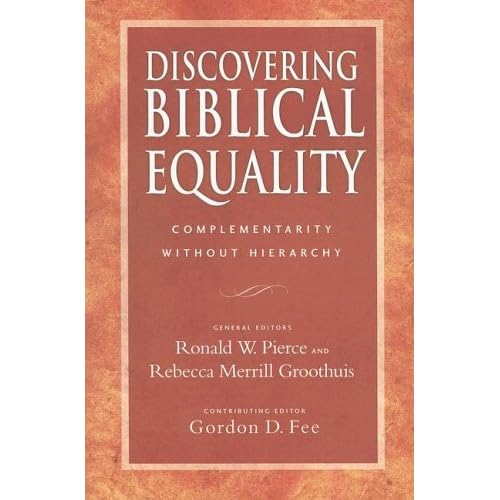
Discovering Biblical Equality

I have been asked for some resources. This is the only major work on men and women in the church that I own. Therefore it is the only one that I can recommend without reserve.

Discovering Biblical Equality: Complementarity Without Hierarchy
by Ronald W. Pierce (Editor), Rebecca Merrill Groothuis (Editor), Gordon D. Fee (Editor)

Here are two good reviews.

M. Aley (hmm - do we know her? thanks Molly)

I found this book *incredibly* helpful as I sought to understand the Scriptures that referred to gender. Having grown up and then attended a Bible College in highly complementarian/patriarchal camps, when I began asking questions about whether or not the "males-rule-females-submit" theology was sound, I wasn't sure where to go for help. (All my life, I'd only been taught the Scriptures in one particular way. Yet as I studied the Scriptures on gender for myself, I began to see something quite different)...

I ended up ordering about 10-12 books explaining egalitarian views, and while some were good, I found *this* book to be wonderful. The chapters handled Bible passages and complementarian/patriarchal arguments with clarity and, always, with a deep scholarly bent. I think I appreciated the footnotes as much as the actual text, and many chapters ended up being "jumping off" points that introduced me to topics I would then study in more depth. In short, I can't recommend the book enough.

Even if a reader ends up disagreeing, he/she will at least gain an accurate understanding of Scriptural backing for why egalitarians don't see male hierarchy as God's ideal. I've heard comp's teach "what egal's believe" often, but rarely do they accurately portray egalitarian thought. Many of the things I'd been *told* egals believe were corrected as I read this book.

The book is not a "novel" but more like a textbook (ie, not for someone looking for a "light read," but rather for study), though I found the writing style to be engaging and highly interesting. If the study of gender and faith is one of interest, this is a book that is a "must-have" in your library.

Here is Adam's review

Rebecca Merrill Groothuis and Ronald Pierce have done the church an extraordinary favor editing this much needed volume that vanquishes the pitiful stereotypes of "evangelical feminism." Far from being sold out to cultural mores, the authors examine biblical and historical sources carefully examining their hermeneutics and philosophy showing the position of universal gender hierarchy to be erroneous and detrimental to the church.

The book's chapter "Equal in Being; Unequal in Role" is worth the money alone in that it delivers a devastating blow to the nonsensical paradigm of "complementarianism." Richard Hess also delivers a fine chapter on "innocence and equality before the fall." William Webb introduces the important "redemptive movement" hermeneutic that is beautifully applied by I. Howard Marshall, and Gordon Fee graces us with his exegetical gifts in delineating the right meaning of Galatians 3:26-28. Not only so, but the ethical chapters on homosexuality, abortion, and abuse are outstanding.

To be sure, there are some weaknesses. Linda Belleville's chapter on 1 Timothy 2:11-15 is helpful at points, but doesn't fully deal with all the issues raised by Kostenberger et al. Giles' Trinitarian thinking is in the right direction, but is triumphalistic and ignores some important facts. However, the books is a winsome apology for the vision of "complementarity without hierarchy" that honors the humanity of both sexes sufficiently and harmoniously.


Ann Nyland

There are many things that I need to write about. However, I was reviewing my links and I noticed that Ann Nyland's works are no longer available online in the original places. I am aware of the reason for the controversy.

I have read Nyland's The Source and some of her other articles. While I don't agree with every single thing she says, same here as for anyone - sometimes I don't agree with myself on a few details - I have learned a tremendous amount from her translation and other works. I heartily endorse them as full of insight about Greek not found elsewhere. I don't think her contribution to translation should be overlooked.

For those who want something a little safer, here is Female Ministry by Catherine Booth.

our flawed human nature

I have received a few emails and read lots of comments so I will just write for a few minutes. I am protesting the placing of prior blame on the woman because she "rebels against authority."

If we look back at Gender and Grace, page 44, by Mary Stewart Van Leeuwen we read,
    In Gen. 3:16, the woman is being warned that she will experience an unreciprocated longing for intimacy with the man. … "[she] wants a mate and she gets a master, she wants a lover and she gets a lord, she wants a husband and she gets a hierarch.”

That's a little more like it. I argue that men and women both, humanly and in their flawed way, long for intimacy and resist giving someone else the authority/permission/liberty or what-have- you to love them. Women and men both, abuse, abandon, and betray. We are a sorry lot.

For some of us our longing for intimacy will never be reciprocated. So we just need to do all the things that make us fully human. We need to be active, have friends, and belong to a community. We need to feel that we have those for whom we can make a difference. We need to understand the fullness of friendship, engagement with ideas, expression of self, and service for others. We need to have fun.

I am trying to confront the serious extremes of complementarianism. No, I do not think that complementarians as individuals are any worse or better than anyone else. Absolutely not. And I don't worry about who is who on this blog. Yes, if you write a book that caricatures women, I may very well critique it. But I know you won't do that. Thanks to eveyone who reads here my disorganized thoughts.

And if you are "soft comp" then I officially seek forgiveness for any implications that all comps are alike. Anyway, we are all alike, fallible.

I will get down to my email soon.

Friday, July 04, 2008

The debate continues

Some of you might be interested in reading a discussion between John Hobbins and myself at the CBE Blog. Enjoy.

Thursday, July 03, 2008

New Links on Spousal Abuse

I will be adding a few new links on Bruce Ware's sermon here. I will only be picking a few useful responses. Here is the original sermon.

Religion Dispatches
World according to Bruce
Real Liberal Christian Church
Snopes This thread has a particularly fascinating commentary on the early church including pictures of Paul and Theoklia. I recommend also going back to page one and reading the entire thread. It is great to see such balanced and informed voices.
Faith Trust Institute

Authenteo: Resources

In this article by Dr. Kostenberger he writes, page 13,
    41These two references are: Philodemus (1st cent. BCE): “Ought we not to consider that men who incur the enmity of those in authority (συν αυθεντουσιν) are villains, and hated by both gods and men”;

    and BGU 1208 (27 BCE): “I exercised authority (Καμου αυθεντηκοτος) over him, and he consented to provide for Calatytis the Boatman on terms of full fare, within the hour.” For full Greek texts and translations, see Baldwin, “Appendix 2” in Women in the Church, 275–76. (in the PDF page 13)
Here are the two references,

Philodemus
BGU 1208


My argument is that these two texts are not suitable evidence and that we need to go with later evidence that says that authenteo means to rule as a master over a slave; or as God, Christ, the Spirit, a planet or later the pope rules. I argue that it is something which no one should do in church leadership in the NT scriptures.

I am unfamiliar with commentaries but those articles and books which support the point of view that authenteo in 1 Tim. 2:12 has a negative sense (providing evidence) are, to my knowledge, the following,

Linda Belleville a summary
Linda Belleville b Exegetical Fallacies
Linda Belleville c Discovering Biblical Equality
Ben Witherington First and Second Letters to Timothy

Please read these first and then discuss. I regret that these are so limited. There are many more, but I do my own research from primary materials most of the time, so I don't know who else to recommend.


BGU 1208

I have been asked to make the BGU 1208 available online. You can read the Philodemus fragment here. These are the two pieces of evidence that Dr. Kostenberger and Dr. Grudem cite as evidence that authenteo means "to have authority."

I invite anyone to provide a translation of this text. It is full of never seen before Greek words and should be a nice challenge.


Date: 27/26BC ; Location: Herakleopolite

(If this link won't generate so go to Perseus Project, Classics, Papyri, Texts, BGU: Aegyptische Urkunden etc., Table of Contents, Volume 4, Document 1208.)

1
[Τρύφω]ν τῶι ἀδελφῶ[ι] χαίρειν1 καὶ διὰ παντὸς
[ὑγιαίν]ειν. καταντή[σα]ς ἐκ τῶν ἄνωθεν
[τόπων] [[ε̣]] ἐκομισά[μη]ν̣ διὰ Σωτηρίχου
[.c 6] ὃ ἐπιτέθ[εισα]ι̣ τοῖς παρ' αὐτοῦ
5 [πιττάκ]ιον, δι' οὗ [μοι] ἱστορεῖς τὴν
[Καλατύ]τεως πλ̣[άν]η̣ν, ὃ ἀναγνοὺς
[.c 7]ξάμην [τὸν] στρατηγὸν ἐφ' ἧι
[ἐστιν μ]ισοπονηρίαι2 , ἐξ ὧν Ἀπολλώ(νιος)
[.c 6] ἔγραψε [....]τωι. θέλω οὖν σε
10 [ .c 16 ]τ̣ων σημῆναι καὶ
[ .c 16 ]ν̣ ἀ̣ν̣α̣γγέλλοντα
[ .c 12 περὶ] ὧν ἔ[γρα]ψ̣α̣ς̣ ἐντεύξεων
[ .c 20 ]λ̣ε̣ι̣....ρ̣η̣ν̣α̣ι̣
[ .c 16 ]α̣ιν τῶν ἐνκα.
15 [ .c 16 ]α̣ν π̣ε̣ρ̣ὶ̣ φ̣ων...
[ .c 15 τ]ὴν ἀποτομίαν

2
τῆς ἀναβάσεως [οὐ μό]νον χρεωκοπηθῆναι3
ἀλλὰ καὶ χορήγησιν ποιεῖσθαι, εἰκός σε μετειληφέναι
παρὰ τοῦ πολυτιμήτου Ποίλ̣ι̣ος τοῦ μὴ μετα-
20 μελομένου. περὶ οὗ γράψαντός σου εἰς τὸ μὴ
διατρῖψαι4 αὐ[τὸν παρ]αγενηθεὶς εἰς Δικωμίαν
ἠσπασάμη[ν ἐπιθ]έ̣ντος αὐτοῦ πιττάκιον καὶ
ἀποτριβομένου5 μ̣ο̣υ̣ καὶ ἵνα μὴ ἐκπέσηι ἀπο-
τετρῖφθαί6 με αὐτὸ ἐδεξάμην. ἵνα δὲ εἰδῇς
25 τὸ ὄρθριον τοῦ ἀνθρώ(που), πέπομφά σοι ἣν τέθειται
μίσθωσιν, περὶ ὧ[ν ἐ]μ̣νήσθην ἁλ̣ι̣ευ̣τ̣[..].σ̣ι̣ο̣λ̣ας
δὲ̣ ὑ̣π̣ὸ̣ τ̣ο̣ύ̣τ̣ο̣υ̣ π̣ρ̣ὸ̣[ς Π]ετεῆ(σιν) μὴ προσεχ̣[....]
παρ' ἡμῶν. τὸ δὲ [πά]ν̣τ̣ων χ̣ε̣ί̣ρ̣ω̣ τ[ὸ .c 510] τουν̣
π[ο]ρθμεῖον τῆς [τῶν] προβάτων ὠ[νῆς .]ης
30 τῶν ἕως τ̣ο̣ῦ̣ συνκεχωρισμένου̣ τ̣..τα̣σ̣νω̣ε̣.[.]
ὠνῶν ἐπιβαλομένου Ἀντ̣ι̣λ̣ό̣χου καθάπερ ἐ̣π̣ὶ̣
τῶν ἄλλων διαμισθο̣ῦ̣ν, καὶ σ̣ο̣ῦ̣ μ̣ν̣η̣σ̣θέν̣τ̣ο̣ς̣ δ̣α̣ν̣
το̣ῦ̣τ̣ο̣ν̣ συνχρησάμενον τῶι ἄνωθεν ἐπιν̣..α̣ι̣ τῇ̣
χ̣ρ̣ε̣ί̣ᾳ̣ σ̣ου διαμισθοῦν δόξα̣ς̣ συ̣νκαταριθμεῖσθαι, τῆς
35 ληγομένης ὠνῆς σοῦ μνησθέντος εἰς τὸ νῦ(ν)

3
ἐν μηδενὶ ἀντιλογία7
γενηθῆ(ναι) ἐξέστην. καὶ ἐμοῦ8
αὐθεντηκότος πρὸς αὐτὸν
περιποιῆσαι Καλατύτει
40 τῶι ναυτικῶι ἐπὶ τῷ
αὐτῶι φόρωι ἐν τῆι ὥραι
ἐπεχώρησεν. τὴν δὲ
μετὰ ταῦτα ἐξηκολου-
θηκυῖαν ὕβριν μετα-
45 πε[μ]φ̣θ̣εὶς ὑπὸ ωοῦ ὁ
[Καλατ]ύτις ἐξηγή-
[σατό μ]οι ἀκεραίως.
[τὰ δὲ] ἄ̣λλα χαριε̣ῖ̣ τ̣ο̣ῦ̣ σ̣ώ̣μ̣α̣(τος)
[ἐπι]μ̣ε̣(λόμενος) ἵ̣ν̣' ὑγιαίνῃς9 , ὃ̣ δὴ̣
50 μέγιστον ἡγ̣ο̣ῦ̣μ̣[αι].
#26
ἔρρω(σο). (ἔτους) 4 [ ? ]

1 χαιρεν Pap. 2 [μ]εισοπ[ονη]ριαι Pap. 3 χρεοκοπηθηναι Pap. 4 διατρεψαι Pap. 5 αποτρειβομενου Pap. 6 αποτετρειφθαι Pap. 7 αντ[ι]λογια Pap. 8 καμου Pap. 9 υ̣γ̣ι̣ε̣νης Pap.

Wednesday, July 02, 2008

Internet Sit-in

If you disagree with the subordination of women in creation, go and add your two cents worth to this post. You don't have to be a Christian, you don't have to believe in women as ministers, you can just be anyone at all that disagrees with the subordination of women in creation. Put the comments over 1000.

Getting Shrew'd

This is about Taming of the Shrew. I have seen the play very well performed and incredibly funny. It was the Christopher Sly version, one of many permutations of the play discussed here,
    Some years ago, an English director named Michael Bogdanov did a staging of Shrew that took the psychological warfare aspect of the play quite seriously. Petruchio broke Kate to the point where she gave that awful speech as almost a robot. The wedding guests were appalled and slunk away, and at the end, Petruchio was faced with the knowledge that he'd destroyed his wife. Not much of a comedy, maybe; but completely true to the text.

    Another way to do it might be to use the Christopher Sly induction, have the same actor play Petruchio, and at the end reveal that it was all a male fantasy dream while Chris's wife (played by the actress who played Kate) drags him home by the ear.
And that version was hysterically funny to a woman, since the domination of Kate by Petruchio is presented as the fantastical hallucination of a poor drunk whose wife won't let him in the door at night. A pitiable sight he was too.

Tuesday, July 01, 2008

Authority in the church

I have written a lot about authority but always felt that something was missing. How could Paul, who was Jewish, have a view of authority which resembled that of the early popes? And why do some churches say that the church elders, leaders, etc, have "authority?"

Tonight, in the fray over here at Denny Burk's blog, where the comments have gone over 900, and are heading for 1000, a group of women are staging an internet sit-in to protest the complementarian interpretation of Genesis. We defy categorization. We are women whose lives have been touched by complementarianism. We are not secular feminists infiltrating the bibliosphere. We are former/quasi complementarian women who protest our condition as "created for subordination."

Thank you, Bonnie, Molly, Corrie, Gem, Paula, Quixote, Madame, Kathy, Cheryl, Ellen, (on the other side, but also a friend of this blog) We want to buck and chafe against the teaching of eternal subordination. Wouldn't you?

In that conversation, the submission of Christians to the authority of church leaders was mentioned. Here is the verse, Hebrews 13:17,
    πείθεσθε τοῖς ἡγουμένοις ὑμῶν καὶ ὑπείκετε αὐτοὶ

    Be yielding unto them who are guiding you, and submit yourselves; Rotherham

    Obey your leaders and submit to them NASB

    Obey them that have the rule over you, and submit yourselves: KJV

    Obey your leaders and submit to their authority. NIV

    Have confidence in your leaders and submit to their authority, TNIV
Oops. Wow. Ideas that are introduced the this text are "obey," and "authority." Odd, these are the words that are so often also added into marriage relations. If these words were not in the text, why do they need to be added into the text? What impulse causes translators to insert words into the text?

In fact, in the Greek NT, I cannot recall any mention that church leaders have authority over anyone at all.

Luther discovered this very same thing. Its too late for me to dig that out now. Here is how he translated Hebrews 13:17,
    Gehorcht euren Lehrern und folgt ihnen

    Obey your teachers and follow them
Notice how Luther interprets this, "your teachers." The difference between that and the KJV, "those that rule over you" and the (T)NIV, "their authority." The text is coloured by translation and sometimes I don't like the colour.

One could just as properly translate this text as,
    Trust your teachers and follow them.
The authors of the epistles were Jewish, right? And what was the Jewish notion of authority?
    In modern Judaism, central authority is not vested in any single person or body, but in sacred texts, traditions, and learned Rabbis who interpret those texts and laws. Wikipedia
Think on these things.

Do I allow a woman to teach men?

A very good question, Michael. Do you? I need to store this post somewhere and my favourites don't work as well as the blog. This post has a long comment thread which has embedded in it something I am reading about. Hmm.

Men and Women are both God-like

This was Bruce Ware in 2002. (read it in context)
    Women, meanwhile, must "embrace responsibility for respectful, joyful, willing submission and creative assistance in all matters of home and the family," Ware said.

    Referring to Ephesians 5:33, Ware called on wives to submit to and respect their husbands. Just as husbands loving their wives counteracts the effects of the fall, he said submission does the same thing for women.

    "The fall introduced this illicit urge and tendency toward usurpation -- bucking his authority," Ware said. "What this [verse] calls for is respect for his authority and who he is as husband."

    The reason for such a response in women is because it mirrors the relationship of Christ to the church.

    "For how much is the church responsible to submit to Christ?" Ware asked. "In everything."

    Women should recognize that submission is "Godlike," Ware said. "Christ came in submission to the Father. It's not only Godlike to be the authority. It's Godlike to submit to authority."

    As mothers, women are responsible for displaying their respect to the children's father, Ware said, and for requiring the children to respect and submit to his authority.

    "Resist the cultural movement to mock husband and father as a mere buffoon," Ware exhorted workshop participants.
Women are full of illicit urges and are bucking the authority of the husband. You know what has to be done about that. But, no worries, submission is God-like. Women resemble God in their submission, and men in their authority. "It is not only God-like to be an authority, ... "

This is why I believe this is pagan, non-Christian and not something we can deal with. This is the authorized teaching of the Council of Biblical Manhood and Womanhood.

Monday, June 30, 2008

Emotional Abuse

You may wonder why I am linking to all the pages on abuse. I want to pick and choose a few responses. Here is an insightful response,
    As long as you remember that he's stating that he prefers emotional abuse to physical abuse, it all makes perfect sense - it just isn't actually very nice.

    He's not saying that women should be beaten just for the fun of it. He's saving that if a woman gets beaten, its her own fault because either she was disobedient and gave her husband no choice or she chose to marry a non-believer, and neither option is an acceptable choice for a woman.
That's it. The emotional abuse added on to the physical.

Gen. 3:16: Deep seated Misogyny

I don't know how else to describe this. Men and women who are taught these things are deeply scarred.

Ken Sande

    From the context of Genesis 3:1-13, where God is pronouncing curses rather than blessings, we can see that the desire mentioned here is not benevolent and healthy; rather it is a compelling urge to control, to dominate, and to master. That is the effect the Fall has had on wives -- the joy and blessing they would have derived from submission within the authority structure of marriage (established by God before the Fall; Gen. 2:18) has been replaced by an innate desire to control and dominate their husbands.

    This is why wives so easily chafe under authority, even when husbands exercise it in a legitimate way -- as a result of the Fall, submission has become distasteful, not just in marriage, but in all authority structures (just ask your children!). This is why Scripture repeatedly reminds and exhorts those under authority (citizens, members of churches, wives, and children) to overcome their tendency to rebel against it.

    Genesis 3:16 also teaches that the Fall has tarnished the husband's use of authority and the blessing he was meant to derive from it. Instead of the loving leadership contemplated in the creation design (see Gen. 2:18- 25), the husband would be inclined to shirk his responsibilities and abuse his authority.
Dennis Rainey
    Paul says the same to everyone. God has placed the husband in the position of responsibility. It does not matter what kind of personality a man may have. Your wife may be resisting you, fighting you, and spurning your attempts to lead, but it makes no difference. I believe our wives want us and need us to lead. You are not demanding this position; on the contrary, God placed you there. You will not lead her perfectly, but you must care for you wife and family by serving them with perseverance.

Sunday, June 29, 2008

A complementarian Gen. 3:16

The theologians on teshuqa

Kostenberger, page 53-54, explains this word,
    Subsequent to the Fall the judgment pronounced on the woman included that her desire (t'shuqa) would be for her husband (Gen. 3:16), which in all likelihood conveys the woman's sinful desire to manipulate and control her husband rather than to lovingly submit to him. This is suggested by the close parallel in the following chapter, where it is said that sin's desire is for Cain, clearly in the sense of desire or mastery (gen. 4:7.)
Grudem writes,
    Susan Foh has effectively argued that the word translated "desire" (Heb. teshûqah) means "desire to conquer," and that it indicates Eve would have a wrongful desire to usurp authority over her husband. (Systematic Theology. page 464)
Kassian
    The consequences of the fall affect us today. Women experience pain and sorrow n childbearing. Historically, they have sought to usurp male authority and leadership, only to be crushed and oppressed. Men in turn, have abused their God-given role and have been oppressive, domineering, unfair, and unloving. They have often wrongly pronounced women inferior. The modern feminist movement has risen in the past few decades to combat male chauvinism and domination. However, the principle of men ruling over women and women fighting back to overcome this rule cannot be broken by our own efforts. This is not something that has evolved historically and culturally. It is a principle deeply engraved into our sin nature. It is a direct result of the Fall and the judgment of God. Women, Creation and the Fall 28-30
Bruce Ware
    Sin introduced into God's created design many manifestations of disruption, among them a disruption in the proper role-relations between man and woman. As most complementarians understand it, Gen. 3:15-16 informs us that the male/female relationship would now, because of sin, be affected by mutual enmity. In particular, the woman would have a desire to usurp the authority given to man in creation, leading to man, for his part, ruling over woman in what can be either rightfully-corrective or wrongfully-abusive ways.

Touching Testimony

The storm of response to Bruce Ware's sermon has had some positive results. Here is a touching response.

--------------------------

I want to just say bullshit and write this off as another “me Tarzan, You Jane” sermon by a Neanderthal preacher.

But this type of thinking is all to common in Evangelical circles. In the Baptist circles I grew up in this was the predominant view. My wife was taught, as a pastor’s wife, her primary duty in life was to make sure everyone thought well of her husband. She even had a class in how to properly give a tea party. (no I am not kidding)

John R Rice was the predominant family guru and he advocated that women were best served by being at home, married, and pregnant.

My wife and I started married life with the John R Rice philosophy of family. I worked. She stayed at home and had babies. She did work for a time in the Church daycare or Christian School but those types of jobs didn’t count. (and she was paid like they didn’t count. The Church paid men more than women)

I was the head honcho, chief of the tribe, CEO of our family. I ruled the kingdom with a rod of iron. I made all the decisions.

And we had a lousy marriage.

It is a wonder we survived the first five years of marriage. I was (and can still be at times) pretty temperamental during the early years of our marriage. As the boss of the home I would draw a line and say ”this is it”. Inevitably ,my wife would cross that line and then the war would begin.

What was the root problem? Her unwillingness to “submit”?

Or perhaps I was the root problem. I was taught to be the “head of the home” and I was going to be the head no matter what. When my wife refused to comply with my lordship I would react angrily. Fortunately, I never physically beat my wife, but I sure made her pay in other ways.

Such is the fruit of the teaching that Bruce Ware espouses. I am sure I will be rejected as nothing more than an extreme case, but many years of pastoral ministry brought me into contact with hundreds of guys just like me. Poorly taught complementarians (though few would have known that label)who hurt their families and often destroyed their marriages.

Fortunately for my wife and I (and my children) I saw the error of my way. Time and study has brought me to the egalitarian position, and I have watched the liberating effects of it in the life of my wife, and my own life.

We are co-heirs of the mystery of life. We walk together, side by side. Truly equal in the eyes of God and I hope in the eyes of each other.

We still battle the after effects of the earlier years of our marriage. My wife still falls into a default mode that allows me to be the “decision maker.” Sometimes, I have to force her (by not making the decision) to make decisions for herself. Our marriage is still a work in progress. We will celebrate 30 years of marriage in a few weeks.

In his sermon mentioned above, Bruce Ware passes the buck.

  • If a man abuses his wife, often the cause is her unwillingness to submit
  • If the man says “yes dear” he is acquiescing to his wife and forsaking his responsibility to be the head of the home and thus is sinning against God
  • Egalitarians are to blame for this problem and the egalitarians are men pleasers and don’t fear God
  • Blame it on the feminists

Well Bruce, this Bruce thinks:

  • Men abuse their wives because they are sinners
  • Men abuse their wives because they are angry
  • Men abuse their wives because they are authoritarian control freaks
  • Men abuse their wives because they have been taught complentarianism, divorced from the teaching of loving their wife as Christ loved the Church and gave himself for it. They are taught law rather than grace.

Several years ago our family attended a very conservative Reformed Church. Great pastor. The services were some of the best we ever attended. Several hundred people attended the Church.

We were accepted rather readily into the Church. We thought, “maybe this is the place where our journey ends. Maybe this will be our Church home.”

Things went along fairly well until one Sunday, in an after Church discussion, my wife mentioned to a group of Church women that she “worked outside the home.” Immediate silence!

From that moment forward we were treated like we had the plague. My wife was the only woman in the Church that worked outside the home. By her doing so she was sinning against God’s order for the family .Never mind her husband was sick and disabled. Sadly, we left this Church several months later.

In the mid 1990’s I pastored a Sovereign Grace Church that believed that women were to keep silence in the Church. Church business meetings were hilarious. If a woman wanted to ask a question she had to ask her husband who would then ask the question for her. At no time was the woman allowed to speak. Single women had to ask an older man to ask the question for her.

One family in the Church took this to the extreme (as if that wasn’t extreme enough) . The wife was converted during our time there.She desired to be baptized. One of our traditions was to have the baptism candidate give a testimony prior to baptism. Her husband refused to allow her to speak in Church so she couldn’t be baptized. This went on for weeks and then one day the wife came into my office crying and wanted to speak with me. She told me she really wanted to be baptized but didn’t know what to do. I told her this “your husband is standing between you and God, You need to disobey him and obediently follow the Lord in baptism.”

Needless to say I started World War lll. The wife was baptized and the husband got over it.

Such is the fruit of complentarianism when it is taken to the extreme. While I do not consider complentarianism sinful I have seen it used as a tool of abuse far too often.

Read the rest of this post . Thanks for writing this.

Saturday, June 28, 2008

Bruce Ware on Spousal Abuse

Oped News
Adirondack Musing
Internet Infidels
Huffington Post*
Dungeon Diary
Fort Worth Feminism
Writechic Press
Postpunkkitchen
Oped News.com
Democratic Underground.com
Think Progress
Ruminations - Lutte contre l’injustice
Under Much Grace
Adventures in Mercy
Complegalitarian
Jim West
EthicsDaily.com
Very Important Stuff
aibhne's favorites
A wife's submission
Intellectuelle *
Baptists Today Blogs
CoffeeTrader
Texas in Africa
Ministry of Reconciliation
World According to Bruce *
Yahoo Answers
Snopes.com
To the ends of the earth
Equality Central *
Because it matters
A dinner at the end of time
Feminist Peace Network

* Recommended Reads (most of these are good, so I'll asterisk more later. Some are not as useful.)

Who is allowed to desire?

There has been some discussion of teshuqa or "desire" in Gen. 3:16 on Denny Burk's blog. I will not enter the fray there on that one. Mainline scholarship still assigns to it the meaning "desire." However, this is the way Kostenberger, page 53-54, explains this word,
    Subsequent to the Fall the judgment pronounced on the woman included that her desire (t'shuqa) would be for her husband (Gen. 3:16), which in all likelihood conveys the woman's sinful desire to manipulate and control her husband rather than to lovingly submit to him. This is suggested by the close parallel in the following chapter, where it is said that sin's desire is for Cain, clearly in the sense of desire or mastery (gen. 4:7.)

    In the third and only other instance of the term translated "desire" in these passages, Song of Solomon 7:10, the woman exclaims, "I am my beloved's, and his desire is for me." Rather than the woman's desire being illegitimately to control her husband, a restoration of the original state is envisioned in which the husband's desire will be for his wife.
Actually, it is hard to make sense of this, but the implication seems to be that for a woman to desire her husband is manipulative control, but for a husband to desire his wife is a return to paradise. Since marriage, in the Eden state, is an authority-submission relationship, desire on the part of the wife is not in view.

This is a major textbook on marriage for complementarians. That's the problem. From other complementarian writing you get the impression that romantic love is quite important and even possibly a mutual affair.

On the next page, 55, Kostenberger contradicts himself, mercifully,
    Liberated from the self-centredness of sin and from the desire to manipulate one's spouse to have one's own needs met, the marriage partners are free to love their spouse in a spirit that is completely self-giving and hence able to love and enjoy the other person without fear of rejection, abuse, or domination.
Here Kostengerger writes in mutual terms of spouses, not the husband vs the wife, etc. He hits the nail on the head. Both spouses, wife and husband, want to be free from a fear of rejection or domination.

Bruce Ware and Kevin Giles

I think some of my readers will be interested in this conversation between Denny Burk and Scot Mcknight about how Ware uses the supposed "eternal subordination of the son" to argue for the "subordination of women." That was almost two years ago. Not much has changed.

Two other women bloggers have jumped in with their opinion on Ware's recent sermon - Molly and Cindy. Several other women that I know have jumped in to comment, but others have emailed that their comments are moderated out.

Here are other blogs which discuss Bruce Ware's sermon on the subordination of women. I also want to make it clear that I think that Ware is only saying out loud what many other complementarians have written.

Under Much Grace
Adventures in Mercy
Complegalitarian
Jim West
EthicsDaily.com
Very Important Stuff
aibhne's favorites
A wife's submission
Intellectuelle
Baptists Today Blogs
CoffeeTrader

Friday, June 27, 2008

Imitation of Christ

Here are a few quotes that have stuck in my mind the last few months. In this passage, men and women both get to imitate Christ. Men imitate his headship of the church and women imitate his submission to the father.
    The husband is called to be the head of the wife in the same way that Christ is the head of the church. He imitates the headship of Jesus Christ. The wife is called to imitate the submission of Jesus Christ to the Father. Jesus Christ is so great that both a man and woman together are needed to display his glorious leadership and servanthood.
Here is Lig Duncan, as reported by Courtney Tartar, on a similar topic.
    Biblical manhood and womanhood must be rooted in the doctrine of the work and person of Christ. Therefore all women's ministry in the local church must rely on the doctrine of Christ. Jesus is the example of perfect submission. The work and submission of Christ radically reorients Christian service for Christian women because it is following in the footsteps of our Savior.
I know that Denny is moderating out some commenters but I don't know on what basis. You are welcome to comment here. Either way. Please be a kind to each other.

Addendum:

Here is more about Gen. 3:16 from Gender blog,
    In the curse pronounced by God upon the newly guilty Adam and Eve the distinctive nature of each part of the curse implies the need for men to protect women. The facet of the curse spoken to women includes vulnerability to the serpent, risk and pain in child-bearing and the spiritual danger of desiring to master her husband. Distinctively, the curse upon men includes difficulty in all matters of the earth, and in providing for oneself and family.
What think ye?

Wednesday, June 25, 2008

The cause of abuse

This is the core of complementarian teaching. This is foundational. Bruce Ware said these words,
    The very wise and good plan of God, of male headship, is sought to be overturned as women now, as sinners, want instead to have their way, instead of submitting to their husbands, to do what they would like to do, and seek to work to have their husbands fulfill their will, rather than serving them;

    and their husbands on their part, because they are sinners, now respond to that threat to their authority either by being abusive, which is, of course, one of the ways men can respond when their authority is challenged, or more commonly by becoming passive, acquiescing and simply not asserting the leadership they ought to as men in their homes and churches.
in a sermon at the Denton Bible Church, June 22, 2008. The teaching goes like this. God created marriage as an authority submission relationship. Eve's sin represents her rebellion against male authority. Eve rebels against her husband, and he responds by being abusive.

Marriage failure, for complementarians, is one of the two patterns, the wife rebels against submission and the husband is either abusive or passive in response. Note who sins first, who causes the mess in the first place. Christians should have nothing to do with this teaching. The doctrine of male headship as it is taught by complementarians like Dr. Ware, who summarizes the complementarian position for CBMW, is simply wrong. Why are we so hesitant to say this?

The discussion is continuing on Denny's Blog. Thanks Denny for keeping this open.

Sunday, June 22, 2008

Authenteo: to lord it over someone harshly

I have been asked for occurrences of authenteo previous to the fourth century. This is the complete list of all occurrences of authenteo previous to the fourth century AD other than 1 Tim. 2:12.

( 1 cent. BCE) BGU 1208 (27 BCE): “I exercised authority (Καμου αυθεντηκοτος) over him, and he consented to provide for Calatytis the Boatman on terms of full fare, within the hour.”

This can also be translated as "prevailed on" or "compelled". The context was hostile.

(2nd century) Ptolemy Tetrabiblos "If Saturn alone is ruler of the body and dominates mercury and the moon."

(2nd cent. AD) Moeris, Attic Lexicon "to have independent jurisdiction"

(3 cent. AD) Hippolytus (d. AD 235) On the End of the World. De consummatione mundi, in Hippolyt's kleinere exegetische und homiletische Schrften, ed. H. Achelis in De griechischen christlichen Schriftsteller, 1.2 (Leipzig: Himrichs, 1897), 239-309.

Translation: my own [that is, Baldwin]
    Therefore, everyone will walk according to his won desire, and the children will lay hands upon their parents, a wife will hand over her own husband to death and a man his own wife to judgment as deserving to render account. Inhuman masters will have legal authority over their servants and servants shall put on an unruly disposition toward their masters.
Cited from Evangelical Feminism and Biblical Truth. pages 680-682.

In an online edition of the church fathers this passage is translated as,
    Wherefore all shall walk after their own will. And the children will lay hands on their parents. The wife will give up her own husband to death, and the husband will bring his own wife to judgment like a criminal. Masters will lord it over their servants savagely, and servants will assume an unruly demeanour toward their masters.
So clearly authenteo meant to "lord it over someone." And just in case that does not sound bad enough, the author has added "savagely." One can hardly argue that the connotation is not negative.

Saturday, June 21, 2008

Response to the Open Letter

In 1998 Dr. Grudem wrote an Open Letter to Egalitarians. Mike Seaver of Role Calling has copied it onto his blog. I have asked if Mike would consider my response to this letter. Here is a copy of the original letter with responses by Linda Belleville and Dr. Grudem's rebuttal.

I would also like to make an attempt to put the answer to three of the points in this letter in a fairly simple form, and have people respond to this.

1 Kephale [head]

Dr. Grudem writes,

Specifically, we cannot find any text where person A is called the “head’’ of person or persons B, and is not in a position of authority over that person or persons.

One occurrence of kephale that Dr. Grudem often cites is,
    The King of Egypt is called "head" of the nation in Philo, Moses 2.30, "As the head is the ruling place in the living body, so Ptolemy became among kings."
The full citation for this is,
    the whole family of the Ptolemies was exceedingly eminent and conspicuous above all other royal families, and among the Ptolemies, Philadelphus was the most illustrious; for all the rest put together scarcely did as many glorious and praiseworthy actions as this one king did by himself, being, as it were, the leader of the herd, and in a manner the head of all the kings. Moses 2:30
Philadelphus is described as the head of all the kings, because he is the most illustrious. The kings, of whom Philadelphus was the "head," are the other kings in the family of the Ptolemies. This reference includes Ptolemy 1 Soter, who was the founder of the Ptolemaic dynasty and the father of Philadelphus.

Philadephus was, for two years, a co-regent with his father, but he was not the authority over his father. This passage also refers to the descendants of Philadelphus, who were kings and queens after him. The king of Egypt was not the "head of the nation" as Dr. Grudem cites, nor was he the authority over the kings that he was head of.

We can rightly say that,
    Person A, Philadelphus, was called the "head" of person B, Ptolemy Soter, and Philadelphus was not in a position of authority over his father, Ptolemy Soter.
2. Hupotasso - [to submit, yield]

Dr. Grudem writes,

Will you please show us one example in all of ancient Greek where this word for “be subject to’’ (hypotassō, passive) is used to refer to one person in relation to another and does not include the idea of one-directional submission to the other person’s authority?

Here are two clear examples,

1 Clement 38.1:
    “So in our case let the whole body be saved in Christ Jesus, and let each man be subject (ὑποτασσέσθω) to his neighbor, to the degree determined by his spiritual gift,”
2 Macc 13.23,
    ”[King Antiochus Eupator] got word that Philip, who had been left in charge of the government, had revolted in Antioch; he was dismayed, called in the Jews, yielded (ὑπετάγη) and swore to observe all their rights, settled with them and offered sacrifice, honored the sanctuary and showed generosity to the holy place.”
In the first case, Christians are to be subject to their neighbour, and in the second, the king is subject to his subjects.

We can rightly say that (hypotassō, passive) is used to refer to a Christian in relation to his or her neighbour and it does not include the idea of one-directional submission to that other person’s authority.

3. Authenteo - 1 Timothy 2:12 "to have authority" or "to dominate"

Dr. Grudem writes,

Our problem is this: we have never seen any clear example in ancient Greek literature where authenteō must mean “domineer’’ or “misuse authority." Whenever we have seen this verb occur, it takes a neutral sense, “have authority’’ or “exercise authority,’’ with no negative connotation attaching to the word itself.

It was originally thought that there were two occurrences of authenteo preceding the epistle to Timothy. Here is the first one,
    Philodemus (1st cent. BCE): “Ought we not to consider that men who incur the enmity of those in authority (συν αυθεντουσιν) are villains, and hated by both gods and men”;
In fact, this is from a reconstructed fragment. The text cited is from a short summary of the reconstructed text. It is not a translation and there is no connection between the reconstructed phrase συν αυθεντ[ου]σιν and "those in authority." συν αυθεντ[ου]σιν occurs near the beginning of the fragment, and "those in authority" is at the end of the summary.

The only other occurrence of authenteo during this period is provided by Grudem as,
    BGU 1208 (27 BCE): “I exercised authority (Καμου αυθεντηκοτος) over him, and he consented to provide for Calatytis the Boatman on terms of full fare, within the hour.”
In fact, the translation "exercised authority over" is not the usual translation for authenteo in this citation. Other scholars suggest "prevail on" "compel" and "made him." In the footnote of Evangelical Feminism and Biblical Truth, page 680, Dr. Grudem mentions that this letter refers to a "hostile" relationship, and the meaning "compel" seems appropriate. If it is a hostile relationship, then one presumes it has a negative connotation.

Here is a clearly negative use of the word authenteo from the 2nd/3rd century,
    Wherefore all shall walk after their own will. And the children will lay hands on their parents. The wife will give up her own husband to death, and the husband will bring his own wife to judgment like a criminal. Masters will lord it over their servants savagely, and servants will assume an unruly demeanour toward their masters. Hippolytus, On the End of the World 7.
Clearly authenteō has an negative connotation. It is the way a master rules a slave. Is this the proper exercise of authority in the church? In fact, these are the only occurrences of the word authenteo from the 1st century BCE to the 3rd century AD apart from its use in an astrology text.

We can rightly say that the word authenteo
has a negative connotation attaching to the word itself.

Saturday, June 14, 2008

No, woman is not our brother

There may be much to criticize in the life of Simone de Beauvoir. That does not nullify her writings. Here is the Conclusion to her book The Second Sex. I have excerpted the beginning and end of this chapter,

      ‘NO, WOMAN is not our brother; through indolence and deceit we have made of her a being apart, unknown, having no weapon other than her sex, which not only means constant warfare but unfair warfare – adoring or hating, but never a straight friend, a being in a legion with esprit de corps and freemasonry – the defiant gestures of the eternal little slave.’

    Many men would still subscribe to these words of Laforgue; many think that there will always be ‘strife and dispute’, as Montaigne put it, and that fraternity will never be possible. The fact is that today neither men nor women are satisfied with each other. But the question is to know whether there is an original curse that condemns them to rend each other or whether the conflicts in which they are opposed merely mark a transitional moment in human history.

    -------

    To begin with, there will always be certain differences between man and woman; her eroticism, and therefore her sexual world, have a special form of their own and therefore cannot fail to engender a sensuality, a sensitivity, of a special nature. This means that her relations to her own body, to that of the male, to the child, will never be identical with those the male bears to his own body, to that of the female, and to the child; those who make much of ‘equality in difference’ could not with good grace refuse to grant me the possible existence of differences in equality.

    Then again, it is institutions that create uniformity. Young and pretty, the slaves of the harem are always the same in the sultan’s embrace; Christianity gave eroticism its savour of sin and legend when it endowed the human female with a soul; if society restores her sovereign individuality to woman, it will not thereby destroy the power of love’s embrace to move the heart.

    Then again, it is institutions that create uniformity. Young and pretty, the slaves of the harem are always the same in the sultan’s embrace; Christianity gave eroticism its savour of sin and legend when it endowed the human female with a soul; if society restores her sovereign individuality to woman, it will not thereby destroy the power of love’s embrace to move the heart.

    It is nonsense to assert that revelry, vice, ecstasy, passion, would become impossible if man and woman were equal in concrete matters; the contradictions that put the flesh in opposition to the spirit, the instant to time, the swoon of immanence to the challenge of transcendence, the absolute of pleasure to the nothingness of forgetting, will never be resolved; in sexuality will always be materialised the tension, the anguish, the joy, the frustration, and the triumph of existence.

    To emancipate woman is to refuse to confine her to the relations she bears to man, not to deny them to her; let her have her independent existence and she will continue none the less to exist for him also: mutually recognising each other as subject, each will yet remain for the other an other.

    The reciprocity of their relations will not do away with the miracles – desire, possession, love, dream, adventure – worked by the division of human beings into two separate categories; and the words that move us – giving, conquering, uniting – will not lose their meaning.

    On the contrary, when we abolish the slavery of half of humanity, together with the whole system of hypocrisy that it implies, then the ‘division’ of humanity will reveal its genuine significance and the human couple will find its true form. ‘The direct, natural, necessary relation of human creatures is the relation of man to woman,’ Marx has said. ‘The nature of this relation determines to what point man himself is to be considered as a generic being, as mankind; the relation of man to woman is the most natural relation of human being to human being. By it is shown, therefore, to what point the natural behaviour of man has become human or to what point the human being has become his natural being, to what point his human nature has become his nature.’

    The case could not be better stated. It is for man to establish the reign of liberty in the midst of the world of the given. To gain the supreme victory, it is necessary, for one thing, that by and through their natural differentiation men and women unequivocally affirm their brotherhood.

There is nothing in even this feminism of de Beauvoir about men and women being the same. Rather we see that men and women are equal in their relations to each other and that woman have the full rights of all humans. That women not exist within a caste system. If woman were welcomed as brother, then woman would be treated as an equal.

To call a woman a "brother" and to exclude her from the rights of being a "brother" by which I mean an "equal" is to nullify her existence, to make her contigent in every way on the male. Such is the condition of women in some churches.

Just as Christianity has been the friend of slavery and oppression, so has feminism been the friend of communism and many other constructs we now disapprove of. I hope people can read this and learn a little bit about the impact of words. This book is part of our intellectual history and illuminates the meaning of the word "brother" as an equal. Too bad some Christians have squandered their linguistic heritage and emptied the word of the meaning of equality.

Friday, May 23, 2008

Ada Blackjack

Since I was tagged to write about an impossible dream I have been wondering what to write. At the same time I have been reading the incredible drama of Ada Blackjack. Ada Blackjack is about a 23 year old Inuit woman who went on an Arctic Expedition organized by Vilhjalmur Stefansson in 1921. She went along to sew for the four young men who were to spend the year on Wrangel Island for some poorly conceived hairbrained reason.

The four young men are sent off with only enough food for six months as they are to live off the land. It seems that they did not even have adequate winter clothing since they panic when Ada does not get down to her sewing tasks right away. It soon becomes evident that of the four well-educated, fit and intelligent young men, none of them are a good shot with the rifles and ammunition dwindles as scarce game escapes their efforts to bring in an adequate food supply. Ada simply refuses to touch the guns at all and seems to have the idea that since she is sewing for the crew, she should be fed by them.

At the end of the first year one young man is seriously ill with scurvy and the food supplies are low. However, Steffanson does not have the resources to get a ship to the island to pick them up in spite of the pleading of the parents of the young men.

Finally realizing that their food and ammunition is running low, three of the group take the dog sleds and head north hoping to cross the ice to Nome, Alaska. They are never heard of again.

Ada and Knight are left together at the original camp. By this time Knight is seriously ill and Ada must now learn to shoulder the rifle and hunt for their survival. Day after day, she takes on the new task. She learns to handle the recoil. She learns to aim and bring down birds. She eventually is able to kill and retrieve a seal.

However, Knight, lying in bed, immobilized by scurvy is no longer able to swallow enough fresh meat to recover. He slowly wastes away and dies. Ada is left alone on Wrangel Island with a gun, the expedition cat, Knight's Bible and a typewriter. One of the passages that touches her deeply is the story of the Samaritan woman. Ada was a young Inuit woman, already married and divorced, the outsider of the group. The only survivor, she lived on after the others were gone with the Bible as her companion. At the end of the second year Ada is rescued. What we read in this book comes from her records and the diary of each of the young men.

Why do I think of this book as the impossible dream? I have a collection of books on Arctic exploration inherited from my mother and grandmother. I simply sat down and read them all one summer. Somehow, I think of the frontiers of the wilderness as their impossible dream. Why would two Victorian women make their main interest Arctic exploration? These books are, for the most part, devoid of a woman's point of view. This is the first time that I have read about Arctic exploration from the diary of a woman. Subtly the entire topic of Arctic exploration has shifted for me.

The story is told sympathetically and characters of the young men are drawn from interviews with relatives and letters from the parents, as well as diaries. How poorly prepared they all were! Ada had no special skill at survival as an Inuit. She accepted the challenge of survival when all other hope was gone. This story is fantastically well told and draws on amazingly detailed diaries. I highly recommend it but I do rejoice that Arctic exploration is not my impossible dream. Nonetheless we all have some notion of a personal frontier that we are reaching towards, whatever that may be.

Sunday, May 18, 2008

One corner

This garden is full of the memories of my childhood. The Solomon seal, lily of the valley, and bleeding heart were favourites of my tiny self. They seemed to me in my childhood to be Biblical plants. The rest are poppies, ajuga, and oxalis. Other plants in the picture but not in bloom are foxgloves, oregon grape, hellebore, lamium, and heuchera. I cant believe that I forgot to mention the forget-me-nots!

Friday, May 16, 2008

Weird Worship

Growing up I went to meeting on the Lord's day in an old meeting hall. The brown linoleum floors had many cracks and wrinkles which provided much food for thought on those long Lord's morning breaking of bread services.

The voice of a woman was not heard in the hall while the meeting sat. The men, on the other hand, had every one of them to be ready at all times to share a word given by the Lord. My grandfather had his three favourite chapters from the scriptures, Gen. 22, Ps.. 22 and Phil. 2. He must have had a thing about two's. I don't know what.

We used to kneel by the wooden two-runged chairs during the long weekday evening prayer meetings . And some of the older young people learned to time the prayers. The longest one was 25 minutes. Oh, Lord, have mercy on our souls.

The occasions of weird worship from those long ago days are these.

In our meeting there was an older woman who was afflicted with a chronic condition of the hiccoughs. She could not control this, and once every ten or fifteen minutes, she would emit a resounding hiccough. And so every Lord's day, the Lord was never worshiped without the voice of a woman joining in.

One weekday evening as we knelt in worship and prayer, the boy who knelt beside his parents in the row behind us got bored and inserted his head between the rungs of the chair. He rotated his head and was then unable to extricate his head from its cage. He shook the chair in panic and had to be gently held and have his head ever so gently rotated back and withdrawn from between the rungs.

My grandfather lived with us in his final days before he died of Alzheimer's. He would often not go to bed before he had gathered his grandchildren in the living room for worship, and had read to us one of his favourite passages from the Bible, and then sent us off to bed. After that, he was sent to bed himself and we would reemerge to carry on with our homework.

A tired father, at the end of a long working day, came home at supper time, and directly took his place at the head of the table where all his children sat waiting for him to bless the meal. He bowed his head and closed his eyes and as if answering the phone, wearily incanted, "Maple Dairy."

A woman bent over the kitchen sink and immersed her hands in the warm suds. She started to wash the dishes then stood in quiet thought and slowly withdrew her hands and dried them on her apron. She reached over to the counter and took a kleenex tissue from a box and carefully spread it out on her head. She returned her focus to the sink and quietly worshiped as she washed.

Tuesday, May 13, 2008

Jewish Women in the Middle Ages

On Jewish Women’s Writings


One interesting example of the latter form of publication is the story of Rashi and his daughters. While many know of Rashi's liberal attitude towards his daughters' donning of tefillin, few may have heard that towards the end of his life, as Rashi grew ill, his daughters actually wrote many of his halachic responsa for him. As a battle wages on today over the issue of whether or not women can give halachic psak, this historical precedent is certainly worth considering.

Meanwhile, other learned Jewish women of the time were unabashedly writing works under their own names. Dulcie, the respected wife of Rabbi Eleazar of Worms, was known as a religious poetess. In addition, she would give public lectures on Shabbat, and in this way supported her family. She died in 1215, murdered by two Christian Knights of the Cross.

Then, too, there were women copyists like Paola, the granddaughter of Rabbi Nathan ben Yehiel (1035-1110), who transcribed Biblical commentaries that may still be read today in Breslau archives. While transcription is hardly a form of original expression, it does attest to a level of scholarship achieved by women of this time, as well as the apparent social acceptance of women writing.

Further evidence of this can be found in letters composed by women of this period which survived in the Cairo Genizah. Many of these letters are written in elegant Hebrew and reference various Biblical stories even as they speak of everyday affairs. For example, one letter written by Lady Maliha to her family in Egypt, opens with the following wish:

"May peace from Heaven...be bestowed upon you...and a long life like his who became father of the people, or his who was bound as a victim on a high mountain, or of Jacob, the plain man, or of him who sprinkled blood on the altar seven times."

Maliha's words attest to her knowledge of the stories of the patriarchs and Aaron the high priest. Thus many women at this stage were well-educated and had begun to write on a variety of topics, though none had yet published a halachic work under her own name.

During the Middle Ages, many more women began to write everything from memoirs to epics to halachic teshuvot.. The causes of this increase in authorship are numerous. The first major reason we have more literature from women of this period is simply historical: the more recent the era, the more documents will remain in our possession. Second, technological advances meant that writing implements and surfaces were more accessible.

Third and most importantly, by the fourteenth century, women's education had begun to improve dramatically. In the secular world, particularly Renaissance Italy, all kinds of educational opportunities were opening for interested ladies. The trend spread to the Jewish world, and in 1475, a group of Italian Jewish women began to operate a Talmud Torah for girls in Rome.

Literacy was increasing as well, and while many women still could not understand Hebrew, various Yiddish novels and mussar books were published for their benefit. This development allowed for the cultivation of a larger literary appreciation among women who might otherwise not have opened a book at all.

In the synagogue, where women had trouble reading and comprehending the Hebrew prayers, a tradition began of appointing a zogerke, a woman who would help lead the others through the service. Additionally, in the seventeenth century, Jewish men and women began to compose tkhines, or Yiddish prayers, written for women who felt too isolated by the Hebrew prayers they could not understand. The increasing communal commitment to women's education, literacy, and inclusion in ritual allowed for a dramatic increase in female authorship.


Erasmus Greek-Latin Bible


1516 Erasmus Greek-Latin Parallel
New Testament: First Edition
An influential and very early work. We are not aware of any other copies for sale in the world. This edition was used by Tyndale to translate the New Testament into the English language for the first time. It was also used by Luther to translate the New Testament into the German language for the first time. Most scholars consider the 1516 Erasmus Parallel New Testament, in either the 1516 or the 1519 printing, to be one of the top ten most important books ever printed.

ERASMUS, Desiderius, ed.
Latin and Greek New Testament
Basle: Johann Frobern: 1516

This is the first edition of this work, which was dedicated to Pope Leo X, whose courteous reply was printed in later editions of the book; nevertheless the publication was a great impetus to the Reformation and Luther's German New Testament was done from the second edition; Erasmus' own new Latin translation, printed parallel to the Greek Text, is different from the Vulgate, which papal authority subsequently declared should be used exclusively.

-----


Since Greek and Latin were printed side by side, I contend that no Bible lacks influence from Erasmus Latin paraphrase/translation. We know Tyndale was influence by Luther's translation and Coverdale mentions Pagnini. Do we really think that Tyndale was uninfluenced by a translation that was directly under his nose?


Photo: Ricoblog


Monday, May 12, 2008

Nechama Leibowitz

On Iyov's blog,
    Observant Judaism has a rich tradition of women teachers. Any list of the top ten Bible teachers of the twentieth century would certainly include the great genius Nechama Leibowitz. Nechama was a deeply observant Orthodox Jew. She won the highest award granted to Israeli residents, the Israel Prize, very soon after it was created. She trained both men and women, and taught at Tel Aviv University and Hebrew University. Her studies on the Torah are deep, and are still popularly consulted. (I consult them regularly -- and although I never met her, I consider her to be a deeply influential teacher to me.) Some of her gilyonos in English translation are collected here and in Hebrew here (HT to Gil Student for the Hebrew link).

    (Note: while many of her materials are online, I recommend buying the multi-volume edition of her works -- this page sells her sets in both Hebrew and English.) Read the rest here.

In case you don't know Iyov, if he were a Shakespeare play he would be Hamlet. I answered that quiz myself, got a little muddled up on their website, didn't even like the play I turned out as, and decided not to post my results. But hey, it's a lot more fun than which church father you are.

Oh, this was my diagnosis. I think this is accurate enough.

You scored 27% = Tragic, 39% = Comic, 39% = Romantic, 30% = Historic

Hey, wait a minute. I am way more historic than that. What gives? Just post it, Suzanne, post it.

Leaving church

I read this post on leaving church at Pen and Parchment and I thought that I would write a quick response.

I did leave church.

I had attended a variety of fundamentalist assemblies and churches throughout my life, ending up at an evangelical Anglican church. It has increasingly come under the influence of the Sydney Diocese in Australia and Bishop Barnett was frequently invited to teach during the summer.

I finally left that church and did not attend any church for a full year. I did meet for Bible study in a variety of ways, but I did not attend a church per se. I wanted to be protected from the teachings of "church." My experience was that church had a combative atmosphere, and consisted of narrowing the perspective on a variety of issues, including women.

However, in the time that I did not go to church, I was unable to replace my previous negative experience with something better. Recently I have started to attend a local church which I appreciate very much.

Four passages of scripture are read every Sunday, communion is celebrated every Sunday, the sermon was surprisingly evangelical, and the priest is also a skilled cantor. That rather took me by surprise. I hadn't heard a service conducted like that before.

There is a strong focus on serving the local community, graduating new candidates for the priesthood and growing as a community. I enjoy the after church coffee, too. Actually they serve particularly good coffee.

There is also no powerpoint, no modern choruses, no handwaving, etc. Not that there is anything wrong with that. The sanctuary is quiet throughout the service, which seems to be a combination of the nature of the service and the acoustics. Hmm.

I even took communion without making sure that I did not have to receive communion from a male. I always used to avoid the men during communion in the other church because I would not receive communion from a person who treated me as one of that special class of humans that are not of his class of human, if you know what I mean. In that church, although women were not allowed to preach they could pass out communion. I was always grateful for small mercies.

This isn't very focused but I want to record the feelings that I had in church this morning. I felt safe for a change. I am thankful for this community and grateful to be somewhere else and not where I was. These are just thoughts on my particular situation. Just anecdotes. I am sure other people have their reasons for leaving church. And going back.

Friday, May 09, 2008

To dictate to

Is this the proper exercise of authority in the church? Many suggest that it is. They say that a woman shall not teach or "exercise authority" over a man. 1 Tim. 2:12. And they infer from this that a woman should not have a leadership role in the church. Even those who believe that a woman should have leadership in church still think that this is what this verse says. Hmm.

Here is the verse,
    διδάσκειν δὲ γυναικὶ οὐκ ἐπιτρέπω οὐδὲ αὐθεντεῖν ἀνδρός ἀλλ' εἶναι ἐν ἡσυχίᾳ

    I do not permit a woman to teach or to have authority over a man; she must be silent.
However, the BDAG has,
    authenteo, (Philod., Rhet. II p. 133, 14 Sudh.; Jo. Lydus, Mag. 3, 42; Moeris p. 54; cp. Phryn. 120 Lob.; Hesychius; Thom. Mag. p. 18, 8; schol. in Aeschyl., Eum. 42; BGU 1208, 38 [27 BC]; s. Lampe s.v.) to assume a stance of independent authority, give orders to, dictate to w. gen. of pers. (Ptolem., Apotel. 3, 14, 10 Boll-B.; Cat. Cod. Astr. VIII/1 p. 177, 7; B-D-F §177) avndro,j, w. dida,skein, 1 Ti 2:12 (practically = ‘tell a man what to do‘[Jerusalem Bible]; Mich. Glykas [XII AD] 270, 10 ai` gunai/kej auvqentou/si t. avndrw/n. According to Diod. S. 1, 27, 2 there was a well-documented law in Egypt: j, cp. Soph., OC 337-41; GKnight III, NTS 30, ’84, 143-57; LWilshire, ibid. 34, ’88, 120-34).—DELG s.v. authenteo. M-M.
In fact, every Bible translator knows that this is the lexical meaning for authenteo in 1 Tim. 2:12.

This verse was translated over the centuries as a synonym for the Hebrew mashal "to rule" or "be a tyrant" in Gen. 3:16. So how does this look, if we put Gen. 3:16 and 1 Tim. 2:12 together?
    καὶ πρὸς τὸν ἄνδρα σου ἡ ἀποστροφή σου καὶ αὐτός σου κυριεύσει LXX

    διδάσκειν δὲ γυναικὶ οὐκ ἐπιτρέπω οὐδὲ αὐθεντεῖν ἀνδρός GNT


    et sub viri potestate eris et ipse dominabitur tui Jerome's Vulgate

    ocere autem mulieri non permitto neque dominari in virum Jerome's Vulgate


    und dein Verlangen soll nach deinem Manne sein, und er soll dein Herr sein. Luther

    Einem Weibe aber gestatte ich nicht, daß sie lehre, auch nicht, daß sie des Mannes Herr sei Luther


    and thy desire shall be to thy husband, and he shall rule over thee. KJV

    But I suffer not a woman to teach, nor to usurp authority over the man, KJV


    Your desire shall be for your husband, and he shall rule over you." ESV

    I do not permit a woman to teach or to exercise authority over a man; ESV

So where did the switch come from? Erasmus, in 1516, paraphrased Jerome's Vulgate and wrote, "authoritatem usurpare" instead of "dominari" and then Tyndale, in 1525, translated the Latin of Erasmus as "to have auctoritie" and the KJV, 1611, as "to usurp authority."

There never has been any evidence that authentein meant "to have authority" in a positive sense, or it would be quoted in articles, I would assume. In fact, I believe that Tyndale simply misunderstood how usurpare was to be translated.

It is also worth noting that Erasmus did not translate the Hebrew scriptures so he may have been unaware of how Jerome had made the Hebrew mashal and the Greek authentein synonymous in his translation.

There is good reason for Jerome doing this. Each of these words are used for astronomical bodies.
    And God made the two great lights: the greater light to rule (mashal) the day, and the lesser light to rule (mashal) the night; and the stars.

    Ptolemy, Tetrabiblos III.13 [#157] (second century A.D.): "Therefore, if Saturn alone takes planetary control of the soul and dominates (authenteō ) Mercury and the moon ..." Gen. 1:16
I suggest that Jerome was right in translating authenteo as dominari. I often wonder if there is adequate evidence to consider "to have authority" as an alternative meaning for authentein, but so far I haven't seen any. I don't think authentein refers in any way to the proper exercise of leadership in either church or home. We should simply accept the meaning as presented in the BDAG, if there is no contrary evidence. Just my thoughts.

I hope others can make use of this. I am tired of knowing that those who read the scriptures in English see something different from what I see. It makes me feel alone.

I have written more about the lexical evidence here.

Monday, May 05, 2008

Cathie Nicoll

I wrote about Cathie Nicoll the other day, but it was absorbed into the larger context,

    In the local church that I attended women had also been welcome in the pulpit. One occasional speaker was Cathie Nicoll, a long-time Inter Varsity worker who received the Order of Canada. She was a mentor of my mother and a much respected Bible teacher.

    However, about 10 years ago the local congregational climate changed toward women. The priest was from the diocese of Sydney and Jim Packer was an honourary assistant.

    After Cathie Nicoll passed away, I believe that no other women ever stood in the pulpit on a Sunday morning. This was a deliberate decision of the priest although I am not sure that the congregation was ever consulted on this practice. It is contrary to the expectations of Canadian Anglicans.

A reader of this blog emailed me,
    I just read your post about Cathy Nicoll. Interesting. She led my late mother in law to Christ as well. My late mother in law grew up in Winnipeg. She became a believer while in college (nursing) and was a great dear friend of Cathy Niccol.
Then yesterday on the phone a friend told me about how she went to the hospital every day to stay with Cathie in the last few days of her life before she died in Calgary at the age of 93, in 2004. It made me happy to think that such a warm and loving person was with Cathie during that time.

We also talked about Cathie's sermon planning before she came from Calgary to preach at St. John's Shaughnessy for the last time. My friend was in Calgary and discussed the sermon before hand with her and I was in Vancouver to hear her sermon. It was well accepted. I missed hearing women preach after that.

Cathie worked with Inter-Varsity and Pioneer Camps all her life. She mentored many young people, both men and women, and preached with the bishop in the audience.

Here are a couple of links for Cathie Nicoll. Leading Women, and Imago.
    Cathie Nicoll, or “Nicky”, as she was known to thousands of students and friends from Newfoundland to Vancouver Island, left us peacefully on May 3, 2004. Born of Scottish missionary parents in Chefoo, Shantung, China. In September of 1930, Noel Palmer, Inter-Varsity’s first full-time General Secretary, hired a half-time secretary to assist him in the office for the grand sum of $10 a week. And so, Cathie began her half-century of work with Inter-Varsity, a fledgling student mission. Cathie was instrumental in beginning Inter-School Christian Fellowship, Varsity Christian Fellowship and Teachers’ Christian Fellowship in Jamaica. As mentor and Bible teacher, she influenced a generation of students and campers. In 1987, her remarkable role among youth in Canada was recognized by the Rt. Hon. Jeanne Sauve when she received the Order of Canada. Her contribution to Inter-Varsity’s work and her profoundly biblical leadership principles were demonstrated in the 1990 video “This May Be Your Life’s Work”.
This is one more installment in my series, (so far unlabeled, sorry) of "faithful women." Previous faithful women featured here are Grace Irwin, Elizabeth Wilson, Florence Li Tim Oi, Catherine Booth and Marie Dentiere.

Friday, May 02, 2008

The LCMS report on authentein

I have been asked to comment on the concluding sentence of the LCMS Authentein report, Adopted April 16, 2005,
    In the Commission’s view the English Standard Version accurately translates 1 Timothy 2:12: “I do not permit a woman to teach or to exercise authority over a man; rather, she is to remain quiet.”

This document reviews studies of authentein by Wilshire, Knight, Baldwin, Kostenberger and Wolters. However, my response is that the evidence quoted in the studies reviewed does not support the above conclusion, but demonstrates that the meaning of authentein is more likely "dominate," as Jerome translated it in the Vulgate.

In fact, of 82 examples of authentein in the Baldwin report, only one precedes the epistle to Timothy. (The next occurrence is one century after the epistle, and refers to astronomy.)
    BGU 1208 (first century B.C.): "I had my way with him [authenteō ] and he agreed to provide Calatytis the boatman with the full payment within the hour."
This citation is listed in the original study by Baldwin under the meaning of "to compel, to influence someone." and Grudem agrees with the translation "compel." (Ev. Fem & Biblical Truth. page 677 - 680.) According to Grudem other translators suggest "prevail" and mention that this is a hostile relationship involving insolence.

However, on his blog, Biblical Foundations, in this post, 1 Timothy 2:12—Once More, 06-16-06, Kostenberger writes,
    the likelihood was suggested that “exercise authority” (Grk. authentein) carries a neutral or positive connotation, but owing to the scarcity of the term in ancient literature (the only NT occurrence is 1 Tim. 2:12; found only twice preceding the NT in extrabiblical literature) no firm conclusions could be reached on the basis of lexical study alone.
The two pieces of evidence which Kostenberger cites are,
    41These two references are: Philodemus (1st cent. BCE): “Ought we not to consider that men who incur the enmity of those in authority (συν αυθεντουσιν) are villains, and hated by both gods and men”;

    and BGU 1208 (27 BCE): “I exercised authority (Καμου αυθεντηκοτος) over him, and he consented to provide for Calatytis the Boatman on terms of full fare, within the hour.” For full Greek texts and translations, see Baldwin, “Appendix 2” in Women in the Church, 275–76. (in the PDF page 13)
Note first that the citation from Philodemus does not exist. This fragment is made available here, and clearly it is not possible to tell whether the verb authentein was ever in the fragment, nor how to translate it. Kostenberger has associated the words συν αυθεντουσιν at random with the English phrase "of those in authority" although there is no warrant for this. This evidence should be set aside.

For Kostenberger, the second piece of evidence, BGU 1208, has the phrase "exercise authority." This is a strange thing to say if you are an average citizen without any official capacity, but you made sure that someone else did something within an hour. The letter that this line is taken from is one of a collection of family letters with no reference to official capacity. It would be best to understand that authentein means simply "made him" or "compelled him" as even Grudem admits in Ev. Feminism and Biblical Truth.

So, in sum, the one piece of evidence is rather negative, and not, as Kostenberger says, "neutral or positive." However, Kostenberger does admit that, "no firm conclusions could be reached on the basis of lexical study alone." I conclude that Kostengerger's research does not offer sufficient basis for agreeing that authentein could mean "to exercise authority over" in a neutral or positive sense.

Another important study quoted by the LCMS study is that of Al Wolters. However, his study covered the cognates of authentein and only referred summarily to authentein. Because of the vagueness of Wolters' conclusions in that study I emailed him and received this response,
    I've puzzled long and hard over authentew in BGU 1208 and in the Philodemus fragment. Although most of the lexicographical authorities seem to give it the meaning "have authority over" in those contexts, I don't think anyone can really be sure. Most people ... are too sure about their conclusions in this regard. I do think it's quite well established that authentes and its cognates often have to do with mastery and authority.
These are the very tentative conclusions that Wolters makes. However, these studies by Kostenberger and Wolters are the very studies which the LCMS report uses to come to its conclusion.

One study which was not considered by the LCMS report was "Teaching and Usurping Authority: 1 Timothy 2:11-15" (Ch 12) by Linda L. Belleville in Discovering Biblical Equality, 2004, ed. Pierce and Groothuis.

In this study Belleville provides the information which I used to find the original publication of the Philodemus fragment and establish that it is not readily translatable. She examines the translation of authentein through the centuries and concludes that Jerome's choice of wording seems most appropriate. The Vulgate translates 1 Tim. 2:12,
Belleville concludes her lexical review of authentein with these words,
    So there is no first century warrant for translating authentein as "to exercise authority" and for understanding Paul in 1 Timothy 2:12 to be speaking of the carrying out of one's official duties. Rather the sense is the Koine "to dominate, to get one's way." The NIV's "to have authority over" therefore must be understood in the sense of holding sway or mastery over another. This is supported by the grammar of the verse. If Paul had a routine exercise of authority in view, he would have put it first, followed by authentein as a specific example. Given this word order, authentein as a specific example. Given this word order, authentein meaning "to dominate"or "gain the upper hand of" provides the best fit in the context. Discovering Biblical Equality, page 216-217
I assume that the reason this study was not quoted by the
LCMS report on authentein is that it was published too recently to have come to the attention of the authors.

It appears from a careful review of all the evidence that there was no connection between the word authentein and the holding of church office or exercising leadership functions. Therefore, this verse should not be quoted, as it often is, to keep women from leadership roles, or to place women under the authority of their husbands.

When assessing a matter of accuracy in Biblical studies it is important to review at least a sample of the evidence independently in order to determine its reliability. Do not depend on the conclusions alone. I feel that pastors should keep up with the best of current scholarship on gender issues, and I would highly recommend Discovering Biblical Equality by Pierce and Groothuis.

I appreciate that many people bring a hermeneutic to the scriptures which accords equal function to women. However, others do not. We are in the best position to serve the church well if we start off with an accurate assessment of the evidence. There is no sense in which this review of authentein is intended to go against the rest of scripture. It is clear that Paul welcomed "leading women" into the early church, and so should we.
    And some of them were persuaded and joined Paul and Silas, as did a great many of the devout Greeks and not a few of the leading women. Acts 17:4 ESV