Showing posts sorted by relevance for query crowther. Sort by date Show all posts

Friday, March 10, 2006

Slaves obey your earthly masters

There is probably no more disturbing verse in the entire Bible than Ephesians 6:5. I read the biography of John Newton, Servant of Slaves, and the biography of William Wilberforce, and Lord Shaftsbury. Understanding how these lives intertwined helped me to understand the role of Christianity in the abolition of slavery.

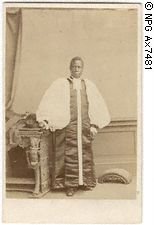
However, the book that guided my reading in graduate studies was the history of Samuel (Ajayi) Crowther written by Ade Ajayi. I quote here from an earlier post.

    Here is the recently published biography of Ajayi Crowther. A Patriot to the Core: Bishop Ajayi Crowther by J.F. Ade-Ajayi, 2002, Spectrum Books, Nigeria.

    Many short versions of his life can be found on the internet. From Great Christians in History;

    "Samuel Crowther (about 1806-91) was the outstanding African Christian leader of his time. Adjai (properly Ajayi) was born in the Egba group of the Yoruba people in what is now Nigeria. When he was about 15, he was captured by slave raiders. But the slave ship was intercepted by a British warship, and Adjai was taken to Sierra Leone where he was converted and baptized, taking the name Samuel Crowther. Outstanding at school (and a foundation pupil of Fourah Bay College) Crowther became a teacher for the Church Missionary Society, ...

    He "became convinced that the evangelization of inland Africa must be carried out by Africans. Ordained in London in 1843, he was appointed to the new mission in his own Yorubaland. ... Crowther achieved much as evangelist, translator and negotiator. He impressed many, including Queen Victoria, when he visited England. He led the new Niger Mission in 1857 and in 1864 became the first African anglican bishop."

    There are several accounts of Samuel Crowther on the internet and most of them end here. This, unfortunately, is a great disservice to history. The truth is that during Crowther's years as bishop, policy and personnel in England changed, and from the time of Crowther's death in 1891 until 1952 there was no other African bishop in the Anglican Church.

    This article from Christianity Today represents the story as I remember it. From the last few paragraphs;

    "Venn's replacement further undercut Crowther's authority by handing control of the Niger Mission's "temporalities" to a committee in 1879, following it the next year by appointing a Commission of Inquiry into allegations of misconduct by Crowther's subordinates...

    All but three of the Niger Mission's 15 Africans were fired. When Crowther protested, he was charged with violating his code of office. He died shortly thereafter, and a white bishop was put in his place. The continent would not see another African Anglican bishop until 1952, sixty years after Crowther's death."

    I read Ade Ajayi's book Christian Missions in Nigeria many years ago and it left a powerful and lasting impression.

    Ade-Ajayi J.F. Christian Missions in Nigeria: the Making of a New Elite. 1965. Longmans. London.

    Ade-Ajayi J.F. A Patriot to the Core: Bishop Ajayi Crowther. 2002. Spectrum Books. Nigeria.
I recommend this author. It pays sometimes to step outside our comfortable, or uncomfortable, selves. People can fuss about how a woman should submit to her husband but some of us have other things to worry about. My husband and I are equally committed to justice for the First Nations of America.

Sunday, June 21, 2009

Carolyn Ann Knight

Carolyn Ann Knight is a preacher with a mission for her people. HT Theophrastus. This article reports,
    She is the founder and president of “CAN DO!” Ministries; a progressive, preventive youth advocacy ministry that is dedicated to the cultural, social, intellectual, and spiritual well-being of youth and young adults. For ten years, Dr. Knight served as assistant professor of homiletics at The Interdenominational Theological Center in Atlanta, Georgia where she had the primary responsibility for teaching and training students in the art and craft of sermonic design, development and delivery.

    A preacher/pastor with scholarly interests, Reverend Knight has served as adjunct professor at LaGuardia Community College and New York Theological Seminary. She served as the permanent part-time professor of preaching at her alma mater, Union Theological Seminary in New York City. Dr. Knight serves on numerous boards and committees; among them are Harlem Congregations for Community Improvement, the Breast Examination Center of Harlem, The Black Leadership Commission on AIDS, and the advisory board of the African American Pulpit of Judson Press.

She grounds her sermons firmly in the gospels and the Hebrew Bible, and addresses social issues with direct talk and action. Here she is quoted as preaching,
    We are a great people with a great history. We must stop reciting the failure studies that have been done on our communities. We must never forget that God has always done great things through Africans. We are formed out of adversity. From it we have fashioned our unique perspective on humanity and divinity. They have us straw. We gave them bricks. They gave us seed. We gave them cotton. They gave us sorrow. We wrote songs....
One of the things that really disturbs me is that the blogosphere is sometimes not very friendly to women or to those of other races. For example, why should we have to read comments like this,
    It's a good thing that slavery is gone and women have equal rights. But is the average African American young man or young woman better off now than their ancestors under slavery? I would hope so, but I am not so sure. What percentage of young black males are currently rotting in prison? What percentage of black children are borne out of wedlock, with all that often means? At the very least, it has to be said that the abolition of slavery solved some problems, created new ones, and left many others unresolved.
In the time I spent in a church in Florida recently, I appreciated that the congregation was aware that racism was an ongoing issue. The problem is not the abolition of slavery. The problem is that the racism and global economic factors which contributed to slavery are ongoing. Isn't that rather obvious? Why blame the abolition of slavery?

    If you are unaware of the fact the vast majority of Christians around the world, who are not, it goes without saying, either white or male, have a *less* nuanced reading strategy vis-a-vis Scripture than does the Chicago Statement, I don't know what to say.
How do we know this is true if we don't read their sermons and discuss them. Just because Carolyn Knight is neither white nor male, does this make her reading strategy "less nuanced?" Is there something fishy going on or is it just me?

Here is one of my earlier posts about Samuel Crowther. The thesis written by his grandson Ade Ajayi had a strong effect on my own MA thesis on First Nations literacy in Canada. I have very emotional memories also of Redfern Louttit, who never did become a bishop, to the disappointment of his people.

Sometimes the bibliosphere is an uncomfortable place. I am happy myself to work in a workplace that has standards about how one talks about those who are neither white nor male.