I have been following a series of posts which started with
The Persistence of Patriarchy by Anne Eggbroten. In this article she visits John MacArthur's church and finds, of course, that the submission of women is alive and well. But she asks,
Here’s the question: Is God permanently committed to the kinds of social hierarchy that existed in the first and second millennium B.C.E. and continued until recently, when education and voting were opened to women? Or does the vision of Paul in Galatians 3:28—“There is no longer Jew or Greek, there is no longer slave or free, there is no longer male and female; for all of you are one in Christ Jesus”—take precedence?
Al Mohler responds to this in his post,
At this point the agenda becomes clear. Eggebroten argues that the church has simply perpetuated the patriarchal traditions of the Jewish and Greco-Roman cultures that formed the social context for the early Christian church. Against these she contrasts the Apostle Paul’s beautiful declaration in Galations 3:28 — “There is no longer Jew or Greek, there is no longer slave or free, there is no longer male and female; for all of you are one in Christ Jesus.”
Ken Pulliam, in turn, weighs in on this,
Eggebroten would like to find a change in perspective on this subject from Paul but she is misguided. In addition to the passages that Mohler cites, Paul also told women to be silent in the church and learn from their husbands (I Cor. 14:34-35) as well as implying that women are more easily deceived than men and need to allow their husbands to make important decisions while they concentrate on motherhood (I Tim. 2:12-15). This was the role of women in ancient cultures (and today in fundamentalist churches) and so, one should not be surprised to find the Bible supporting it.
What I find astonishing here is the weight given to two passages from the epistles, 1 Cor. 14:34-35, and 1 Tim. 2;12. There are arguments which undermine the current interpretation of each of these passages.
Mohler responds to this as well,
To read Galatians 3:28 the way Eggebroten reads the verse, you would have to believe that the Apostle Paul was in direct contradiction with himself, when he restricts the teaching office to men in letters such as 1 Timothy and Titus. Or . . . you can try to deny that Paul actually wrote those latter letters. Eggebroten accuses conservative evangelicals of ignoring “evidence that the ‘pastoral epistles’ (1 and 2 Timothy and Titus) were written in honor of Paul long after he died and reflect a second-century debate over women’s roles in the church–whether to conform to social customs for the sake of winning converts, or to advocate radical social equality (and even celibacy) in the last days before the Second Coming.”
What this reveals, of course, is the argument of many evangelical feminists that we can discard the teachings of the Pastoral Epistles. We can keep the Apostle Paul we like (taking Galatians 3:28 out of context, for example) and disregard the Paul we do not like.
Nor are the Pastoral Epistles the only biblical texts subverted by this line of argument. With reference to 1 Corinthians 14:35 (”Let a woman learn in silence with full submission”), Eggebroten suggests, among other options, that “verses 34-35 began as someone’s marginal comment, later copied right into the text.”
With this approach to the Bible, you can simply discard any text you dislike. Just dismiss it as a marginal comment, or deny that Paul even authored the text. This is where the denial of biblical inerrancy inevitably leads — the text of the Bible is deconstructed right before our eyes.
Mohler is quite well informed on all the arguments against these two passages. Let's review them. First, there is an opinion among many scholars that the letters to Timothy, Titus and the Ephesians were not written by Paul. There is no current consensus on this, so one can only discuss this as a theory.
However, the fact remains that the writings attributed to Paul are often in contradiction. Is he promoting celibacy for single men and women, or is he counselling marriage? Is he advocating reciprocal and matching marital obligations, as in 1 Cor. 7, or asymmetrical ones, as in Ephesians 5. Whether we are reading letters from two different times in Paul's life, or the letters of two different people, there is a contradiction and we need to admit this.
Regarding the status of 1 Cor. 14:34-35 as a marginal note, I find it instructive that the
NET Bible online considers this to be the most likely scenario. Most text critics agree that it was a marginal note at one time, but they vary with regard to when and by whom they believe this note was written, and then incorporated into the body of the epistle.
This is an unusual occurrence. There are no other passages of this length, which began their career as marginal notes, which are now incorporated into the text, without comment in our present Bibles. The Net Bible claims that although they were marginal notes, they were written by Paul.
I guess this begs the question. Is anything written by Paul to be considered canonical? If so, why were other letters, which we know Paul wrote and have been lost, not preserved by the Holy Spirit for posterity? For example, suppose verses 34-35 were written by Paul. How do we know that they were canonical? How do we know that they were inspired by the Holy Spirit and were not just a non-canonical after-thought which came to Paul's mind? Or perhaps Paul did not add this note himself after all.
We do know for a certainty that early manuscript copiers altered the text to reduce the status of women. For example, in the passage referring to the church in Nympha's house, Col. 4:15, the pronoun referring to Nympha was altered to the masculine by a scribe for the purpose of masking the leadership role of a woman.
It is a fifity-fifity choice, in my view, whether 1 Cor. 14:34-35, was added by a scribe who did not like women, or was added by Paul as an afterthought. But we still have to deal with the whether this would qualify as "inspired by the Holy Spirit" or simply Paul's private opinions.
Is it really biblical feminists who are deconstructing the Bible, or is it the reasoned scholarship of text critics in general, both conservative and liberal? Even the most conservative text critics realize that there was something irregular about these verses.
On 1 Tim. 2:12, we have the continued assumption that
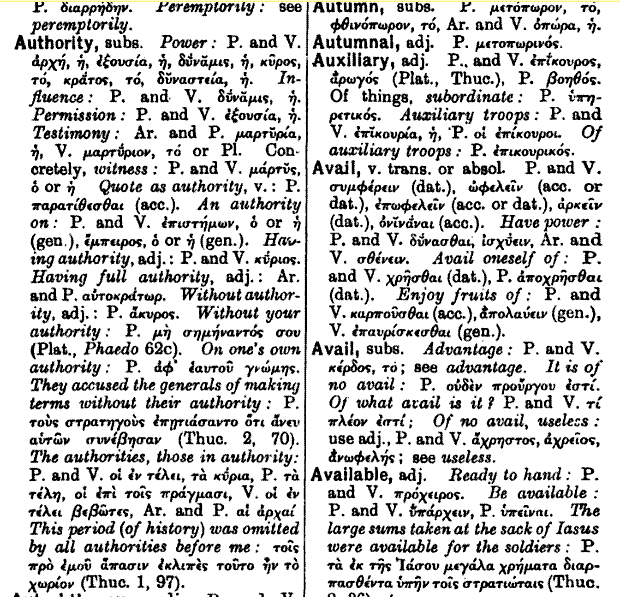
authentein really does say "to exercise authority" which Mohler knows very well is not the lexical meaning of the word. This word is unusual and can only be found 2 or 3 times elsewhere within a few centuries of the epistle. Although there are many cognate words which could enter our discussion, the only times the word
authentein itself was used, it had a negative meaning when it dealt with one person's power over another. It cannot mean that women should not "function as church leaders" - this is not one of the possible meanings of the word - but rather that some particular woman, or women, should not continue in their assumption that women had the right to dominate over men.
Neither 1 Cor., 14:34-35 nor 1 Tim. 2:12 are clear examples of the scriptures forbidding women to participate in the leadership structures. Other scriptures do indicate that Paul was probably speaking to men only, but there is no use of the word "male" and the word for "husband" appears, only to indicate that if married, the person designated as husband must be faithful.
It appears to me that usually, in the letters, Paul was referring to male leadership, but I see no attempt on his part to ensure that leadership be restricted to men only. I do not believe that either 1 Cor. 14 or 1 Tim. 2 are clear enough to fill that function.
In contrast, we have many women who were in leadership position, as head of their house, deacon, apostle, leader of a group of Christians, and so on. These are Lydia, Phoebe, Priscilla, Nympha, Chloe, and the "elect" lady. I can see no other explanation except that Paul did accept women as leaders over a mixed group of people. There seems to be no other way to describe Chloe or Nympha.
While Ken Pulliam describes himself as an agnostic atheist, I would have to call myself an agnostic Christian. I am open to Ken's arguments and do not feel that I have to defend every passage in scripture. I honestly do not find scripture to be a cohesive and clear set of texts. I regret that anyone would try to pick out two or three passages to shape their life, or the life of all women. This is truly misguided. However, I am still sympathetic with the aims of women who engage with the text as biblical feminists.
Zachary has added a personal post on
Christianity and Patriarchy in response to Ken Pulliam.



Kristen and Tim,
To take the slavery example Kristen gives.
Even if you have a wonderful owner isn't slavery still abuse? At the end of the day you are not free, you are not equal. In other words you cannot treat a slave so well that it is not abuse to be a slave.
So as far as I can see it would be true to say "Slavery is abuse. Period".
Should patriarchy really be different? Yes, there seem to be many patriarchal marriages where people are happy but isn't the system of patriarchy itself abuse as slavery is?
For some might the lack of awareness that they are not equal and not free be a sign of abuse?
I don't want to make the jump that all patriarchal marriages are abusive in terms of physical abuse. But equally I do want to say
a) physical, spiritual, emotional abuse is more common in patriarchal marriages.
b)if you are not free to be equal then isn't that a form of abuse? ("image of God abuse"?)