How to post a link in the comment section.
<a href="http://englishbibles.blogspot.com/">BBB</a>
becomes the following when posted.
BBB
I have created the first row of code using escape sequences so it doesn't automatically become a link. The second link is made by copying and posting the first sequence. Clear as mud, right. Try it.
Thursday, July 20, 2006
Tuesday, July 04, 2006
Wednesday, June 21, 2006
Recent Posting
No. I have not actually gone away. I have been posting on the Better Bibles Blog. I have recently posted twice about 1 Tim. 2:15, here and here. I am also doing some offblog writing about one of my students. I had wanted to write about myself for a while here to develop a writing style so that I could write about some of the children that I work with better. It is paying off. I am sorry I cannot post my other writing now.
You would never guess from the fierceness of my 'Not saved by childbearing posts' that I am totally surrounded by children at school and at home every day. I visited a blog today that took me back some 15 years to the days when my own little guy played with Thomas the Tank Engine. Oh my goodness!
You never see me here on the blog playing with railroad track, and model planes, and dollsclothes, and my beloved dollshouse, with all the little sylvan critters with their little handknit sweaters and hats. Maybe next Christmas!
If there is any woman who loves the domestic domain it is me. But all the things I love are just that, my affections, and my affectations - they will not save me.
You would never guess from the fierceness of my 'Not saved by childbearing posts' that I am totally surrounded by children at school and at home every day. I visited a blog today that took me back some 15 years to the days when my own little guy played with Thomas the Tank Engine. Oh my goodness!
You never see me here on the blog playing with railroad track, and model planes, and dollsclothes, and my beloved dollshouse, with all the little sylvan critters with their little handknit sweaters and hats. Maybe next Christmas!
If there is any woman who loves the domestic domain it is me. But all the things I love are just that, my affections, and my affectations - they will not save me.
Wednesday, June 14, 2006
Codex Alexandrinus
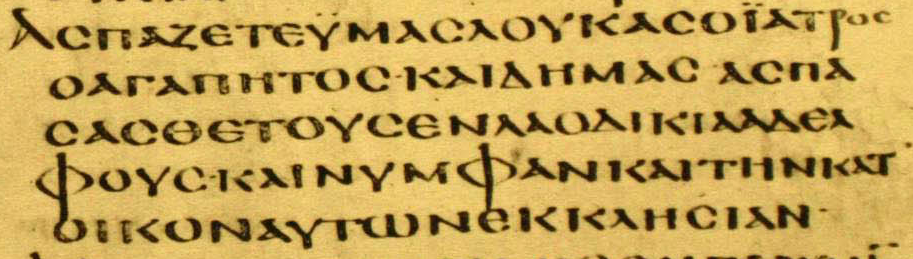
"Our dear friend Luke, the doctor, and Demas send greetings, Give my greetings to the brothers and sisters at Laodicea, and to Nympha and the church in her house." Colossians 4:14-15
The Codex Alexandrinus (London, British Library, MS Royal 1. D. V-VIII) is a 5th century manuscript of the Greek Bible, containing the majority of the Septuagint and the New Testament. Along with the Codex Sinaiticus and the Codex Vaticanus, it is one of the earliest and most complete manuscripts of the Bible. It derives its name from Alexandria where it is believed to have been made.
Sunday, June 11, 2006
Deep Magic
Exploring the writings of contemporary theologians on atonement, I came across articles by Edith Humphrey. She is from Montreal and taught for several years at Augustine College in Ottawa.
Here is a sample of her writing on atonement.
Note: That was a pretty short break. However, these are just things that I am reading, not part of the earlier story which was the first chapter of my blog. I guess I won't stop reading.
Here is a sample of her writing on atonement.
- When we try to ask questions about the necessity of the cross, about the necessity that the God-Man should die for us, words fail. Immediately as we say this, we remember that in the garden, Jesus had a choice, and that is what makes this act all the more wonderful. Rev. 5 speaks of the Lamb, the one who is given as Saviour and Spouse to God’s people, slain from the foundation of the earth.
We are, to use the words of C. S. Lewis, in the realm of “deep magic”, “magic from the dawn of time.” Perhaps, shrinking from the numerous ways that this part of the story is told in the Scriptures, we want to ask, “Why wouldn’t the righteous, perfect life of the Last Adam be enough to effect reconciliation?” Many answers have been given to that, including the importance of God’s justice, and the like.
We may want to speculate, along with a few of our elder brothers and sisters in the Church, that the incarnation might have been sufficient for God to share with us his glory, but because of the fall, the depth of human experience, crucifixion, death, and the utter descent, abandonment, had also to be plumbed. Or, to change the metaphor, the wages of sin is death; Or, to change the metaphor, the Lamb must be a slaughtered as well as a standing victorious Lamb.
Sometimes contemporary theologians point to the multiplicity of images in Scriptures for this great mystery in order to relativise, or to avoid the pictures that they find uncomfortable. What a desolation! The effect of the pictures is to point to a truth that is deeper, not less disturbing or challenging than the stories we currently shy away from -- the atonement was more costly, not less, than a earthly sacrifice; the battle was more intense, not less, than a human conflict; the journey was more arduous, not less, than the toughest human exploration; the price paid was beyond all human reasoning.
-------------
In the end, we go back again and again to Scripture, and to the enacted event of Jesus’ life, death and resurrection, the Eucharist, to be nourished and to have formed in us the mind of Christ. There, we see hear Paul and the gospels insisting on the historicity of what has been done for us, of God’s actions for Israel and through Messiah Jesus for the world, and of the mystery of Victory over sin and Death through the life, death and resurrection of our Lord. There we see them also glorying in the far-reaching aspects of this victory, a victory so deep and intimate that, through the work of the Holy Spirit, it declares innocent but also changes the person, each person who is in Christ, so that “glimpsed” glory becomes increasing glory.
Both Paul in his letters, and John in his visions, bring together the different variations of the story, reminding us that we need all the pictures, all of them accentuated, each of the songs played with all the stops out, each story taken to its fullest climax, without being used to qualifying or nullify the another. In Romans 5:9-11, we hear these words:
- "9 Since we have now been justified by his blood, how much more shall we be saved from God's wrath through him! 10For if, when we were God's enemies, we were reconciled to him through the death of his Son, how much more, having been reconciled, shall we be saved through his life! 11Not only is this so, but we also rejoice in God through our Lord Jesus Christ, through whom we have now received reconciliation."
Here Paul speaks of atonement as justification, as the effect of blood sacrifice, as the removal of God’s wrath, and as reconciliation. John, in his vision, shows to us the Lamb: the Lamb who is both Victim and Victor, the Lamb who Interprets the meaning of the world, opening the scroll of mystery, the Lamb who also Mystifies, showing things that are beyond our ken, the Lamb who makes his dwelling with us, and is to be our Spouse, and the Lamb who invites -- invites to the tree and water of life.
Note: That was a pretty short break. However, these are just things that I am reading, not part of the earlier story which was the first chapter of my blog. I guess I won't stop reading.

Thursday, June 08, 2006
Paula and Jerome
This post is dedicated to my brother who emailed suggesting that I write about Paula. It seems fitting that this last post should be once again directly about women and Bible translation.
Paula was a wealthy widow of the 4th century, who left grown and married children in Rome, and along with her daughter Eustochium, lived in Bethlehem for 20 years in a religious community of men and women, which she built to support the work of Jerome in translating the Latin Vulgate.
She funded and adminstered the four houses of the community, the chapels and the hostel. She requested, urged and compelled the scholar Jerome to pursue and maintain his work on translation and commentary. She studied Greek and Hebrew and worked along with Jerome for 20 years.
Many of his translations are dedicated to her, they traveled together and letters attest to a close relationship. Although he outlived her for many years, he was buried beside her.
He wrote to Paula and her daughter,
In spite of all my intentions to close this blog until next fall, I may drop in from time to time. People occasionally hand me a book and say "This is for your blog!"
As for the rest, remember the good and forget the bad. I hope you have enjoyed some of the stories that were told to me.
Paula was a wealthy widow of the 4th century, who left grown and married children in Rome, and along with her daughter Eustochium, lived in Bethlehem for 20 years in a religious community of men and women, which she built to support the work of Jerome in translating the Latin Vulgate.
She funded and adminstered the four houses of the community, the chapels and the hostel. She requested, urged and compelled the scholar Jerome to pursue and maintain his work on translation and commentary. She studied Greek and Hebrew and worked along with Jerome for 20 years.
Many of his translations are dedicated to her, they traveled together and letters attest to a close relationship. Although he outlived her for many years, he was buried beside her.
- In some privileged late medieval circles, where religious men and women were mingling with a measure of freedom for devotional and instructional purposes, the relationships of early saints such as Jerome and the widow Paula perhaps provided an inspirational model for later similar pairings, and one that implicitly endorsed not only the education of women but also the act of translating sacred texts into the vernacular. Here
He wrote to Paula and her daughter,
- There are people, O Paula and Eustochium, who take offence at seeing your names at the beginning of my works. These people do not know that Olda [Huldah] prophesied when the men were mute, that while Barak trembled, Deborah saved Israel, that Judith and Esther delivered from supreme peril the children of God. I pass over in silence Anna and Elizabeth and the other holy women of the Gospel, but humble stars when compared with the great luminary, Mary.
- Shall I speak now of the illustrious women among the heathen? Does not Plato have Aspasia speak in his dialogues? Does not Sappho hold the lyre at the same time as Alcaeus and Pindar? Did not Themista philosophize with the sages of Greece? And the mother of the Gracchi, your Cornelia, daughter of Cato, wife of Brutus, before whom pale the austere virtue of the father and the courage of the husband --are they not the pride of the whole of Rome? I shall add but one word more. Was it not to women that Our Lord appeared after His resurrection? Yes, and the men could then blush for not having sought what women had found. - Saint Jerome
- ... he addresses her as "my Eustochium, my daughter, my mistress, my companion, my sister," and tells her "my age, your worth, our profession and our love of God, permit me to give you all these names." Here
In spite of all my intentions to close this blog until next fall, I may drop in from time to time. People occasionally hand me a book and say "This is for your blog!"
As for the rest, remember the good and forget the bad. I hope you have enjoyed some of the stories that were told to me.
Wednesday, June 07, 2006
The great-uncles
Before I close this blog for the summer, I want to tip my hat to the great uncles. When I was about 8 years old Great Uncle Harry came to visit. He was about 5 feet tall, 94 years old with a vegetable brush moustache, and a twinkle in his eye.
I thought he was Charlie Chaplin and Graucho Marx, all rolled into one. He was, after all, Great Aunt Elizabeth's brother.
He told stories of driving one of the first 3 cars in Montreal. There were no speed limits, no traffic signs, and if you got in an accident you didn't report it to the police you just drove the wreck home. Those were the good old days.
Mother was disapproving. She pursed her lips as if he was a recalcitrant teenager that she was obliged to make us be polite to. We were simply fascinated. But we were not, let me repeat, not, allowed to go out for a drive with him.
Not long after we drove up to the townships to visit Great Aunt Ruth. Her husband, Great Uncle Sid had died a few years back. He had been a businessman, a financial success, a stable and worthy citizen, who did not get into traffic accidents.
We trailed around their spacious old house, filled with petit point china, and doilies and tea cozies. We admired the garden and the photographs of the family.
Only last week someone told me that Uncle Sid was the one in the family who knit. He and his sister, my grandmother.
That makes 4 generations of men in our family who have had their fingers into some kind of needlework at some point in their life. But I will not mention the others. Great Uncle Sid has been dead for 50 years. He will not mind.
I thought he was Charlie Chaplin and Graucho Marx, all rolled into one. He was, after all, Great Aunt Elizabeth's brother.
He told stories of driving one of the first 3 cars in Montreal. There were no speed limits, no traffic signs, and if you got in an accident you didn't report it to the police you just drove the wreck home. Those were the good old days.
Mother was disapproving. She pursed her lips as if he was a recalcitrant teenager that she was obliged to make us be polite to. We were simply fascinated. But we were not, let me repeat, not, allowed to go out for a drive with him.
Not long after we drove up to the townships to visit Great Aunt Ruth. Her husband, Great Uncle Sid had died a few years back. He had been a businessman, a financial success, a stable and worthy citizen, who did not get into traffic accidents.
We trailed around their spacious old house, filled with petit point china, and doilies and tea cozies. We admired the garden and the photographs of the family.
Only last week someone told me that Uncle Sid was the one in the family who knit. He and his sister, my grandmother.
That makes 4 generations of men in our family who have had their fingers into some kind of needlework at some point in their life. But I will not mention the others. Great Uncle Sid has been dead for 50 years. He will not mind.
Tuesday, June 06, 2006
Sally Ironside
By an odd circumstance Sally Ironside was another of the great-aunts in my family connection. She was also a cousin of Harry Ironside, the Plymouth Brethren preacher and writer.
During WWII she worked in London as the deputy head of scientific information for Canada. God gives women the same gifts he gives their brothers and cousins, but sometimes women may only use their gifts outside of the church.
During WWII she worked in London as the deputy head of scientific information for Canada. God gives women the same gifts he gives their brothers and cousins, but sometimes women may only use their gifts outside of the church.
Sophie Scholl
In Germany during WWII, Sophie Scholl, a young Christian woman, worked with her brother Hans Scholl and his friends to write anti-Hitler slogans on walls and distribute 'leaflets of the resistance'. These were called 'Leaflets of the White Rose.' Hans and Sophie Scholl and Christoph Probst were arrested, sentenced and guillotined in 1943.
Sophie Scholl: The Final Days is a recent movie about the last six days of her life. I haven't seen it yet, but I do remember seeing The White Rose in 1983.
It is the last few minutes of June 6, D-day, here in Vancouver.
Sophie Scholl: The Final Days is a recent movie about the last six days of her life. I haven't seen it yet, but I do remember seeing The White Rose in 1983.
It is the last few minutes of June 6, D-day, here in Vancouver.
Monday, June 05, 2006
John G Stackhouse
I had put this on the backburner but it is important. On May 10, 2006 I attended a forum at Regent College titled Why Women Don't Lead featuring Maxine Hancock, John Stackhouse and Jeremy Bell among others.
John Stackhouse is the author of Finally Feminist. This book has recently been discussed by Susan Wise Bauer, here on April 8th. She comments that she hopes to review it soon. Her post has created a bit of a ruckus. First, Gender News featured an article of concern about her written by Jeff Robinson. Then Ligon Duncan jumped in on May 26. No doubt others are worried as well.
The event at Regent was pivotal for me. It echoed my reactions the very first day I read a complementarian statement in 1991. This is the statement, written by John Piper in Recovering Biblical Manhood and Womanhood, his uppercase, not mine!
So on May 10, I heard John Stackhouse speak. He is a Canadian former Plymouth Brethren, close to my age, who has taught in a secular university and is now at a Regent College. Since coming to Regent and being in contact with the wider North American Christian community he has become increasingly aware of how other Christians are talking about women.
In his talk he said that he was taken aback by the language that he heard being used about women, especially the terms 'receivers and responders'.
Jeremy Bell, Baptist Union of Western Canada, was even more vociferous on this point. He said that we must absolutely not tolerate the 'immature and socially unacceptable language' that is being used about women today.
He turned and asked Maxine what she did with her anger. She replied that she had been angry for a while, but she had passed her anger on. (I feel it is time to lay my anger down. I don't really wish it on anyone else.)
Jeremy then lost it, really, and said that these ideas were,
I had never heard of these men before, but they echoed closely my own thoughts and feelings. I had written an email last fall explaining to someone that I felt sexually harassed by the way some men talked about women in the Christian community, in a way that I had never experienced in secular society. I was glad to hear Stackhouse and Bell confirm my feelings.
Oddly, when I first voiced similar feelings on this blog a few months ago, a women remarked that I was a good example of how emotional women were, and that is why women should not be teachers and elders. Ha! These were men, men from my own cultural community, and they expressed their emotions considerably more publicly than I have.
Anyway, I feel better now. As Susan Bauer said,
This isn't even about whether women should be ordained. Far from it. This is about getting all that blech language cleaned up.
Anyway, please note that I write about 'some men'. I am not painting with a wide brush. It is great to see a growing community of egalitarian men who are willing to dialogue about this topic. It is much appreciated.
Read Susan Bauer's post and Robinson's response for a better idea of what John wrote in Finally Feminist.
Addenda: Since I never did learn shorthand this is not taken from an exact transcription of the talk. It is close but not exact. The CD can be ordered from Regent College for $5.00.
The room was well-filled, about one third men and two thirds women. The woman sitting beside me was knitting a pair of red socks.
John Stackhouse is the author of Finally Feminist. This book has recently been discussed by Susan Wise Bauer, here on April 8th. She comments that she hopes to review it soon. Her post has created a bit of a ruckus. First, Gender News featured an article of concern about her written by Jeff Robinson. Then Ligon Duncan jumped in on May 26. No doubt others are worried as well.
The event at Regent was pivotal for me. It echoed my reactions the very first day I read a complementarian statement in 1991. This is the statement, written by John Piper in Recovering Biblical Manhood and Womanhood, his uppercase, not mine!
- AT THE HEART OF MATURE FEMININITY IS A FREEING DISPOSITION TO AFFIRM, RECEIVE AND NURTURE STRENGTH AND LEADERSHIP FROM WORTHY MEN IN WAYS APPROPRIATE TO A WOMAN'S DIFFERING RELATIONSHIPS.
So on May 10, I heard John Stackhouse speak. He is a Canadian former Plymouth Brethren, close to my age, who has taught in a secular university and is now at a Regent College. Since coming to Regent and being in contact with the wider North American Christian community he has become increasingly aware of how other Christians are talking about women.
In his talk he said that he was taken aback by the language that he heard being used about women, especially the terms 'receivers and responders'.
- "What is that about?" he said, "using the language of the sex act to talk about women in church. Are nursing mothers receivers anyway? This is ridiculous." [He just wasn't prepared to say any more on that topic, we are Canadian after all.]
- "Men must repent of their sexual reading of women."
Jeremy Bell, Baptist Union of Western Canada, was even more vociferous on this point. He said that we must absolutely not tolerate the 'immature and socially unacceptable language' that is being used about women today.
- "Women have to try out their voices and be angry and be unhappy, and men have to sit and listen to their pain."
He turned and asked Maxine what she did with her anger. She replied that she had been angry for a while, but she had passed her anger on. (I feel it is time to lay my anger down. I don't really wish it on anyone else.)
Jeremy then lost it, really, and said that these ideas were,
- "a stinking lesion, the elephant in the room."
I had never heard of these men before, but they echoed closely my own thoughts and feelings. I had written an email last fall explaining to someone that I felt sexually harassed by the way some men talked about women in the Christian community, in a way that I had never experienced in secular society. I was glad to hear Stackhouse and Bell confirm my feelings.
Oddly, when I first voiced similar feelings on this blog a few months ago, a women remarked that I was a good example of how emotional women were, and that is why women should not be teachers and elders. Ha! These were men, men from my own cultural community, and they expressed their emotions considerably more publicly than I have.
Anyway, I feel better now. As Susan Bauer said,
- "sometimes discussions about the reliability of the Bible are actually discussions about men’s fears of women"
This isn't even about whether women should be ordained. Far from it. This is about getting all that blech language cleaned up.
Anyway, please note that I write about 'some men'. I am not painting with a wide brush. It is great to see a growing community of egalitarian men who are willing to dialogue about this topic. It is much appreciated.
Read Susan Bauer's post and Robinson's response for a better idea of what John wrote in Finally Feminist.
Addenda: Since I never did learn shorthand this is not taken from an exact transcription of the talk. It is close but not exact. The CD can be ordered from Regent College for $5.00.
The room was well-filled, about one third men and two thirds women. The woman sitting beside me was knitting a pair of red socks.
Sunday, June 04, 2006
Alzheimers and memories
 I have written before about my high school Greek teacher, a British Plymouth Brethren, Elizabeth Wilson, who now suffers from alzheimers. Here is another memory from those long hours when she taught me as a lone Greek student.
Most of our classes revolved around Homer's Iliad and Odyssey, with special attention to the passages about young women. We also read chapters of Acts, but little else in the NT. It was a classics course. However, I was also required to write a paper about the Proverbs 31 woman.
My remaining impressions were that a woman should learn how to weave, which I did; have servants, which I do not; and finally, buy and sell real estate.
We never really talked about the 'women in the church' issue, but she did make one comment that I remember still. She said,
"Things have not gone well for women in England since the Roman church took over from the Celtic church."
She spoke as if she was talking of events that had taken place the year before. I raised my eyebrows. As my adolescent brain climbed the ladders of time, I discounted the Tractarian controversy, Bonnie Prince Charlie, and poor old James II - didn't he escape in a row-boat? I finally settled on Queen Mary, bloody Mary, surely that is what she was talking about.
Looking pained at my ignorance of early British history, she explained that she was refering to Hilda of Whitby, who was abbess in Northumberland in the 7th century. And so I learned then of the legacy of the Celtic church and came later to read Caedmon's song and the Dream of the Rood. I understood that my teacher felt the loss of the rich spirituality of men and women together, with the immediacy of a recently lost legacy, not something clouded by the passage of millenia.
Hilda was the abbess of a religious community of men and women together. She was a teacher of theology and was consulted by royalty. Northumberland became a great centre of learning at that time.
Hilda also hosted the Synod of Whitby where certain ecclesiastical differences between the Celtic and Roman churches were settled. Since that time the Roman church gained influence in England. At least that is how I understood it.
- Almost all of our knowledge of St. Hilda (Hild) is derived from the writings of the Venerable Bede. Her correct name, Hild, means "battle." She was born in Northumbria in 614, the daughter of Hereric, the nephew of King Edwin of Northumbria, making her King Edwin's grandniece. She, like her great-uncle, was brought to Christ through the preaching of St. Paulinus, who baptized her in 627 at the age of 13 when King Edwin and his entire household became Christians.
She lived the life of a noblewoman until 20 years later when she was moved by the example of her sister Saint Hereswitha who became a nun at the Chelles Monastery in France. Hilda intended to follow her sister abroad, but St. Aidan persuaded her to return to Northumbria in 649. She was initially put in charge of a small group of women who were also aspiring to the religious life at a small house on the River Wear, but Bishop Aidan soon realized she was ready for wider responsibilities.
There was a much larger and fully established religious house of women at Hartlepool whose Foundress, Bega (St. Bee), was founding a new house at Tadcaster. Hilda was called to take her place as Superior. St. Hilda ruled at Hartlepool for some years with great success before being called to found a monastery at Streaneshalch, a place to which the Danes a century or two later gave the name of Whitby.
St. Hilda governed the monastery at Whitby for the rest of her life. Under Abbess Hilda, Whitby gained a great reputation, becoming a burial place for kings, and a place of pilgrimage. The fame of St. Hilda's wisdom was so great that from far and near monks and royal personages came to consult her. Whitby was also a double monastery: a community of men and another of women, with the chapel in between, and Hilda as the governor of both. It was a great center of learning, especially the study of sacred scripture.
Whitby was known as a place where clergy, monks and nuns could receive a rigorous and thorough religious education. The arts and sciences were so well established by her that it was regarded as one of the best seminaries for learning in the then known world. No less than five of her subject monks later became bishops, including Saint John of Beverly, and Saint Wilfrid of York.
St. Hilda was especially revered for her ability to recognize spiritual gifts in both men and women. Her kindheartedness can be seen from the story of Caedmon, one of her herdsmen, whose poetic gift was discovered and nurtured by Hilda. She encouraged him with the same zeal and care she would use toward a member of the nobility, urging him to use his gifts as a means of bringing the knowledge of the Gospel Truth to common folk. St. Caedmon later composed the first hymns in the English language.
Your sons and daughters will prophesy
Strange things were happening. Simple people (Galileans) started to speak in all sorts of different languages. We are talking about the birth of the church; Pentecost, the descent of the Holy Spirit. (See Acts 2.)
Then, when there was some confusion and people started to ask themselves what was going on, Peter made a speech. It is remarkable that he cites the Old-Testament prophet Joel on exactly this occasion:
How so, women are not allowed to preach?
Then, when there was some confusion and people started to ask themselves what was going on, Peter made a speech. It is remarkable that he cites the Old-Testament prophet Joel on exactly this occasion:
In the last days, God says, I will pour out my Spirit on all people. Your sons and daughters will prophesy, your young men will see visions, your old men will dream dreams. Even on my servants, both men and women, I will pour out my Spirit in those days, and they will prophesy. (Acts 2:17-18)The disciples were speaking in public about the wonders of God (vs. 11). (Usually we call that preaching...) And exactly on this massive manifestation of speaking in public on the birthday of the church, Peter cites a text about speaking by men as well as women. The prophesying of women is even mentioned twice in this passage.
How so, women are not allowed to preach?
Saturday, June 03, 2006
Wilfred Owen
The Parable of the Young Man and the Old
So Abram rose, and clave the wood, and went,
And took the fire with him, and a knife.
And as they sojourned, both of them together,
Isaac the first-born spake, and said, My Father,
Behold the preparations, fire and iron,
But where the lamb for this burnt-offering?
Then Abram bound the youth with belts and straps,
And builded parapets and trenches there,
And stretched forth the knife to slay his son.
When lo! an angel called him out of heaven,
Saying, Lay not thy hand upon the lad,
Neither do anything to him, thy son.
Behold, caught in a thicket by its horns;
A ram, offer the Ram of Pride instead.
But the old man would not so, but slew his son,
And half the seed of Europe, one by one.
Wilfred Owen
This is a day or two early for D-day but I wish to post this now as my reflection on The Father killed the son.
This poem was written in the first world war about the military establishment of England who would rather sacrifice their young men than back down. The story behind this poem has been written of in Regeneration by Pat Barker and made into a film of the same name. I highly recommend the movie. I had read the book previously but found the movie had more emotional impact. A Canadian book on this topic is Broken Ground by Jack Hodgkins.
I wrote a while ago about how Eva McCarthy lost her brother in WWII. He had been a stretcher-bearer in WWI and although older at the time of WWII, he volunteered as a chaplain's assistant in order to care for the young men who were fighting and be there for them. He died in Italy shortly before the end of the war.
So Abram rose, and clave the wood, and went,
And took the fire with him, and a knife.
And as they sojourned, both of them together,
Isaac the first-born spake, and said, My Father,
Behold the preparations, fire and iron,
But where the lamb for this burnt-offering?
Then Abram bound the youth with belts and straps,
And builded parapets and trenches there,
And stretched forth the knife to slay his son.
When lo! an angel called him out of heaven,
Saying, Lay not thy hand upon the lad,
Neither do anything to him, thy son.
Behold, caught in a thicket by its horns;
A ram, offer the Ram of Pride instead.
But the old man would not so, but slew his son,
And half the seed of Europe, one by one.
Wilfred Owen
This is a day or two early for D-day but I wish to post this now as my reflection on The Father killed the son.
This poem was written in the first world war about the military establishment of England who would rather sacrifice their young men than back down. The story behind this poem has been written of in Regeneration by Pat Barker and made into a film of the same name. I highly recommend the movie. I had read the book previously but found the movie had more emotional impact. A Canadian book on this topic is Broken Ground by Jack Hodgkins.
I wrote a while ago about how Eva McCarthy lost her brother in WWII. He had been a stretcher-bearer in WWI and although older at the time of WWII, he volunteered as a chaplain's assistant in order to care for the young men who were fighting and be there for them. He died in Italy shortly before the end of the war.
Speaker of truth
I have added a few more blogs to my sidebar, and taken a few out - they weren't actually blogs anyway. I missed that when I added them. Hmm.
Peter Kirk has posted on his blog Speaker of Truth commenting on a post at the New Attitude blog. Peter's post is called, "The Father killed the Son": the offence of the Gospel? I was surprised to read the New Attitude post and Mahaney's sermon - it seems to extrapolate from scripture into areas that God has chosen not to reveal, so I am glad to see Peter respond to this post.
I have also added Lingamish, which means linguist and missionary. And True Grit, a woman's blog that has also been following the egalitarian/complementarian debate.
Peter Kirk has posted on his blog Speaker of Truth commenting on a post at the New Attitude blog. Peter's post is called, "The Father killed the Son": the offence of the Gospel? I was surprised to read the New Attitude post and Mahaney's sermon - it seems to extrapolate from scripture into areas that God has chosen not to reveal, so I am glad to see Peter respond to this post.
I have also added Lingamish, which means linguist and missionary. And True Grit, a woman's blog that has also been following the egalitarian/complementarian debate.
Blogdrift, comments and technicalities
I have now drifted considerably from my original intentions on this blog. My posts have varied from argumentation to narrative. The narrative posts have helped me explore my identity as a Christian woman, a former Plymouth Brethren, and a Canadian.
I have emailed some of the posts about women to members of my family and they have enjoyed them. However, when I did this I felt that I needed to hide the comments on that post since these stories are personal and family stories. I beg forgivness of those who may have found their comments hidden. However, some of these stories need to be read by themselves. Since I wish to use these stories over again, I thought that I would occasionally, after a week or two, hide the comments on those few more personal posts. That does not lessen the appreciation that I have for the comments. Thank you.
I need to remark on a couple of housekeeping matters. I am aware that the 'search this blog' function does not work on my blog and I have not got around to fixing it. I have also not organized my posts into categories. I hope to look into this soon.
I plan to break off for the summer in the next few days.
I have emailed some of the posts about women to members of my family and they have enjoyed them. However, when I did this I felt that I needed to hide the comments on that post since these stories are personal and family stories. I beg forgivness of those who may have found their comments hidden. However, some of these stories need to be read by themselves. Since I wish to use these stories over again, I thought that I would occasionally, after a week or two, hide the comments on those few more personal posts. That does not lessen the appreciation that I have for the comments. Thank you.
I need to remark on a couple of housekeeping matters. I am aware that the 'search this blog' function does not work on my blog and I have not got around to fixing it. I have also not organized my posts into categories. I hope to look into this soon.
I plan to break off for the summer in the next few days.
Friday, June 02, 2006
Redfern Louttit
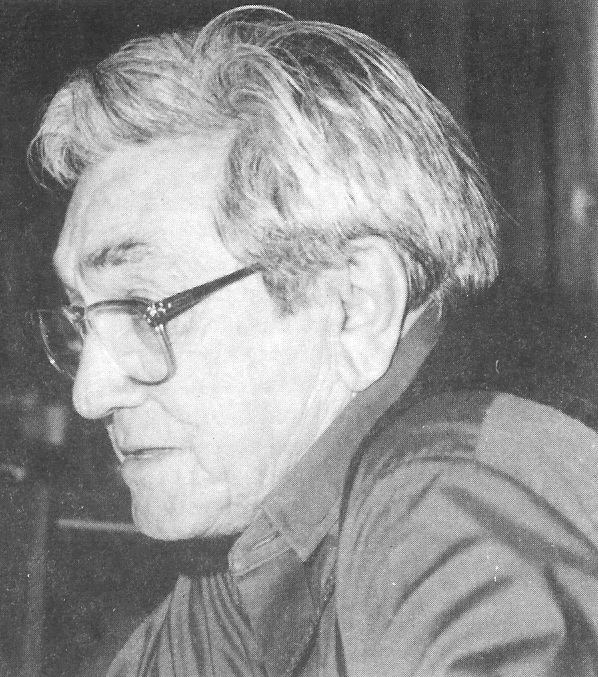 It is hard for me to believe that a person as influential as Redfern Louttit is only mentioned obliquely on the internet, once as the late Redfern Louttit and then again as a distinguished Anglican cleric.
In 1990, I was involved in a study of the use of Cree as a language and literacy in the Diocese of Moosonee in Northern Ontario. I traveled to a clergy retreat in Kirkland Lake with Redfern Louttit and we had plenty of time to talk on the road.
Fortunately I do not have to depend on my own memory to tell you one of the stories he told me that weekend. The Journey, Stories and Prayers for the Christian Year From People of the First Nations, ed. by Joyce Carlson includes this story by Redfern Louttit.
- I was chosen by my family when I was nine years old to be a servant of God, a priest. When I was nine, I went in a canoe with two priests and two paddlers.
I was so far from my home that I never went home until I was eighteen. When I stepped out of the canoe, my parents looked up and said, "Who's that handsome young clergyman?" They didn't recognize me. I couldn't talk to them because they spoke no English, and I had lost my language.
- The teenage years were especially hard. There was a person at the school who was like a foster mother - and she was good to us. But, it wasn't the same as if you had a real father and mother to guide you through the struggles.
My parents had a bit of status in the community because they had a son who went out in this way to be a clergyman - but it was also hard. Although my parents were admired, many of the other people in the community admitted they could not have done the same themselves, to send out a child so young to go to school.
I think it was hardest on my mother. After I left, my father said it was a long time before my mother had her heart in her work. There were others at home, but they say it was very hard on her when I left.
When I was a freshman in university taking theological studies, everybody knew I was an Indian. They had certain ideas of how an Indian would be.
At initiation days in the college, [Wycliffe College, Toronto] because I was an Indian, they had me do an Indian War Dance in the streets of Toronto. They must have given this a lot of thought. They had feathers fastened to a cardboard piece and they fastened it to my head. I stomped around on Bloor Street whooping it up as I thought a war dance would be - although I never saw a war dance in my life. Where I came from, people were Bible-believing Christians. I didn't know what a war dance was!
Well, I must have looked funny.
Since I was an Indian, they thought I must know how to run so they asked me to be on the five-mile running team. I didn't know how to run! I'd never tried to run in my life - but I didn't want to disappoint them, so I said I would. Maybe there was something to it because I trained and learned how to run. Every year that I was there, we won the first prize.
I have a band number. I somehow found it hard, being a number. It was as though I didn't have a name. When I graduated and was a young clergyman, people in the communities I served thought I knew everything - even what the weather would be like the next day. For some reason they thought of someone educated as having all knowledge.
I have had a good life and many opportunities to seve the Lord for over fifty years. My time of serving is over. There are different ways to do things now and a whole new generation of young leaders. They will do things in a different way - and this is good.
In choosing new leaders, I remember the apostles and the difficulty they had in choosing leaders. We have to be careful in the choosing of leaders for our community - but I believe in the Bible and I do by the words.
"Be not afraid; only believe!"
- Prayer for Meditation
Creator,
You are Alpah and Omega,
beginning and end.
May we be wise,
serving you with fear
taking refuge under your wings.
Lord, come,
Stand among us and show us your peace
We long to be believers; help us in our unbelief.
We give thanks for the leaders who have gone before us.
May we, living in the knowldge of or resurrection,
consider in our hearts how we might werve you.
Prayer for all people
That we may be obedient to God rather than to any human authority,
let us pray to the Lord.
Photo credit: The Northland, Autumn, 1990, Diocese of Mossonee, Anglican Church of Canada.
Wednesday, May 31, 2006
Dever, women and slaves
I have just finished reading three blog posts, Adrian's, Justin's and Dever's.
Dever writes the following.
Civil rights for people of different races was an extension of the recognition of equal spiritual authority for women.
No matter what Dever's assessment is of the Quaker movement today, let him know that Quakers acknowledged the right of women to speak in the assembly before their anti-slavery thrust.
In a post that I wrote in March, I mentioned Women Speaking 1666., written by Margaret Fell, the wife of George Fox, founder of the Quakers.
Here is the beginning of the Quaker Testimony to Equality.
Update: My apologies to Dever. I have rethought this post and now admit that older complementarians are probably equally ignorant of the Quaker origins of the abolition movement.
Dever writes the following.
- ... those older than me who are complementarian generally want to downplay this issue, and those younger than me want to lead with it, or at least be very up front about it.
- The older group is among peers who see women's ordination as an extension of civil rights for people of different races.
Civil rights for people of different races was an extension of the recognition of equal spiritual authority for women.
No matter what Dever's assessment is of the Quaker movement today, let him know that Quakers acknowledged the right of women to speak in the assembly before their anti-slavery thrust.
In a post that I wrote in March, I mentioned Women Speaking 1666., written by Margaret Fell, the wife of George Fox, founder of the Quakers.
Here is the beginning of the Quaker Testimony to Equality.
- The Quaker testimony to equality stems from the conviction that all people are of equal spiritual worth. This was reflected in the early days of Quakerism by the equal spiritual authority of women, and by the refusal to use forms of address that recognised social distinctions. Equality is also a fundamental characteristic of Quaker organisation and worship, with the lack of clergy and any formal hierarchy.
- Before the eighteenth century, very few white men questioned the morality of slavery. The Quakers were among these few. The doctrines of their religion declared an issue such as slavery to be unjust. By 1775, the Quakers founded the first American anti-slavery group. Through the 1700s, Quakers led a strong-held prohibition against slavery.
- The Quakers’ fight inspired growing numbers of abolitionists, and by the 1830’s abolitionism was in full force and became a major political issue in theUnited States.The Quakers were radical Christians. They believed that all people were equal in the sight of God, and every human being wascapable of receiving the "light" of God’s spirit and wisdom. They also were against violence.
- Quakers were known for their simple living and work ethic. Therefore, to the Quakers, slavery was morally wrong.It was as early as the 1600s that Quakers began their fight against slavery, and thus the beginning of the abolitionist movement.They debated, made speeches, and preached to many people. By 1696, they made their first official declaration for abolitionism in Pennsylvania, in which they declared they were not going to encourage the importation of slaves.
How dare Christians of other denominations wrest the anti-slavery movement out of its rightful origin? Does no one remember how the Quakers were persecuted by other Christians for their anti-slavery actions?
How long before those of us who are over 50 come to see the younger generation as revisionists and ideologues with no respect for fact?
How many errors will it take before someone signs a few preachers up for History 101?
Dever also writes this about the older group who wish to downplay complementarianism.
- Normal for the older group is evangelicals as upstanding members of the society. They are mayors and bankers and respected persons in the community. The tendency is natural to do what would be culturally acceptable, as much as is possible (parallel to John Rawls and his idea of publicly accessible reasons).
Update: My apologies to Dever. I have rethought this post and now admit that older complementarians are probably equally ignorant of the Quaker origins of the abolition movement.
Monday, May 29, 2006
Florence Li Tim Oi
 I have been enjoying a wonderful weekend with my older sister, listening to her tell the stories of women she has known. One of those women was Florence Li Tim Oi, the first woman to be ordained in the Anglican Communion.
This is an amazing story of a woman who, ordained in wartime and surrendering her priest's license in peacetime, served the church in China throughout the Communist period.
In 1984, she was reinstated in Toronto, Canada, where women had been ordained since 1976. She stands as an older sister to Canadian Anglican women.
- At her birth in 1907 Li Tim-Oi's father called her “Much Beloved”. When she was baptised as a student Tim-Oi chose the name Florence from ‘The Lady of the Lamp’. Florence is celebrated world-wide for the witness to Christ that she lived out as the first female priest in the Anglican Communion. In 1931 at the ordination of a deaconess, she heard and responded to the call to ministry.
She was made Deacon in 1941, and was given charge of the Anglican congregation in the Portuguese colony of Macao, thronged with refugees from wartorn China. When a priest could no longer travel from Japanese-occupied territory to preside for her at the eucharist, the Bishop of Hong Kong asked her to meet him in Free China, where on 25 January 1944 he ordained her “a priest in the Church of God”.
To defuse controversy, in 1946 she surrendered her priest's license, but not her Holy Orders, the knowledge of which carried her through Maoist persecution. For the next 39 years, she served faithfully under very difficult circumstances, particularly after the Communists took over mainland China. In 1983, arrangements were made for her to come to Canada where she was appointed as an honorary assistant at St. John's Chinese congregation and St. Matthew's parish in Toronto.
The Anglican Church of Canada had by this time approved the ordination of women to the priesthood and in 1984, the 40th anniversary of her ordination; Ms. Li was, with great joy and thanksgiving, reinstated as a priest. This event was celebrated not only in Canada but also at Westminster Abbey and at Sheffield in England even though the Church of England had not yet approved the ordination of women.
From that date until her death in 1992, she exercised her priesthood with such faithfulness and quiet dignity that she won tremendous respect for herself and increasing support for other women seeking ordination. She was awarded Doctorates of Divinity by General Theological Seminary, New York, and Trinity College, Toronto.
The very quality of Ms. Li's ministry in China and in Canada and the grace with which she exercised her priesthood helped convince many people through the communion and beyond that the Holy Spirit was certainly working in and through women priests. Her contribution to the church far exceeded the expectations of those involved in her ordination in 1944. She died on 26 February 1992.
--------
This is a blog written by a women who wishes to witness to the spiritual integrity of ordained women, to stand beside them and tell their stories, stories past and stories yet unwritten, about women who answer God's call to serve. In remembrance of Florence Li Tim Oi, may we all exercise our different gifts with grace.
Friday, May 26, 2006
Wilfred Grenfell's Collection
For forty years Wilfred Grenfell, a British doctor, traveled up and down the coast of Labrador, in the summer by steamer, in the winter by dogteam, treating the poor inhabitants. On one occasion he was stranded on an ice floe with his dogteam and soaking wet he almost froze to death. He finally decided that he should make one further attempt to extend his life by a few hours and killed and skinned three of beloved his sled dogs and wrapped himself in their fur. He was rescued a few hours later.
Here is an another incident he describes in his autobiography, Forty Years for Labrador. 1933. It gives you some idea of what kind of man he was and the work he did.
Wilfred Grenfell spoke at the Inter Varsity Fellowship at McGill and Gordon Thomas (PDF) a young medical student at the time, never forgot what he heard. Eventually he and his wife Patty took over the adminstration of the Grenfell mission. When I was little they used to visit my parents and tell stories of the mission and orphanage.
Here is an another incident he describes in his autobiography, Forty Years for Labrador. 1933. It gives you some idea of what kind of man he was and the work he did.
- We had anchored among a group of islands to give the people a chance of coming aboard the hospital ship. Suddenly a boat bumped our side, and a woman climbed over the rail with a bundle under each arm. On my chartroom table she laid the two bundles and proceeded to untie them.
'There is something wrong with them, sir,' she explained. Examination showed that, although their eyes looked right, both chldren were as blind as kittens with congenital posterior polar cataracts.
- 'Have you any other children?' I asked the mother.
- 'Yes, four.'
- 'Where is your husband?'
- 'Killed by a gun accident three months ago.'
- 'Then how do you manage to keep food for the babies?'
- 'Indeed, I can't.'
- 'Whatever are you going to do with them?'
- 'I'm going to give them to you, Doctor.'
- When we got under way it was rough, and the babies made such a noise that the helmsman stuck his head into the chartroom, which was directly behind the wheelhouse, to see what could be the matter.
'What are you going to do with those, sir?'
- 'Shh. They're blind and quite useless. When we get outside. we'll drop them over the rail.'
- He stared at me for a second before he turned back to his wheel. A few minutes later in popped his head again.
- 'Excuse my being so bold, but don't throw them over the side. We've got eight of our own, but I guess my wife'll find a place for those two.
- I did not throw them overboard; neither did I send them to the home of that modern saint. I simply added them to my collection.
In various ways my adopted family grew at an alarming rate, once it became known that we were acting the role of unofficial residuary legatee for derelict children.
- Curiosity led us to peep inside, though there were no signs of life. Suddenly one of the boys, looking up at a hole in the low ceiling, exclaimed, 'Why, there's someone looking down at us through that chink.' In a trice he was up on the lofting. 'There are four naked kiddies up here,' he called down.
- Vermin, the inevitable accompaniment of poverty and squalor, had not been avoided even though the children had no rags to cover them. How could we take them back in our jolly-boat, over the seven miles of open sea, without clothing? In a second every boy with me had his coat off, and a well-clad child in his arms. What a credential of modern youth that act was! When we left, the poor mother brought up the rear of our procession carrying the baby. Today that little family is fed, clothed, going to school, and started on the road to a useful life. Forty Years For Labrador. page 153
Wilfred Grenfell spoke at the Inter Varsity Fellowship at McGill and Gordon Thomas (PDF) a young medical student at the time, never forgot what he heard. Eventually he and his wife Patty took over the adminstration of the Grenfell mission. When I was little they used to visit my parents and tell stories of the mission and orphanage.
Tuesday, May 23, 2006
Excommunication, exclusivism and discipline
I am collecting a few links on these topics. It has nothing to do with women, but quite a lot to do with being in the Exclusive Brethren. I don't see how you can understand your upbringing in an exclusive fellowship, it you don't have a good angle on how and why you were excommunicated.
Of course, by then you have left, you don't sit there and listen to yourself being excommunicated, that is not what happens. I don't even know how and if we were 'read out'. But the 'who can eat with who' conversation hung in the air. It was a borderline kind of thing. Maybe some people don't remember it that way. I do.
Someone who grows up in an exclusive fellowship, unlike someone who has entered it later in life, is bound psychologically in a particular way. The boundaries are firm, you are either on the inside or on the outside. At the table of the Lord, or the table of Demons. But some part of your brain says "oh, come on."
I can't say that is the whole picture, but a segment, a slice of the reality of living in a closed fellowship.
Here are a few links.
Is Fermented Mare's Milk Unclean? Three Hierarchies
The Obligation To Assume Challies
Obligation To Assume: Church Discipline Challies
The Heidelberg Catechism: On Excommunication Jim West
Bullinger: On Excommunication Jim West
The Heidelberg Catechism concerns me.
Bullinger sounds less rigid, but consider this.
There are extensive notes in the comment section of Challies' post so this is a good resource, complementing Jim West's recent posts. I wonder if these people are interested in thinking about this from the point of view of those who have been excommunicated wrongfully. And yet, their arguments do seem persuasive, as long as it isn't happening to you.
Excommunication gives opportunity for an abuse of power. On the other hand, Know ye not that a little leaven leaveneth the whole lump? At what cost? To whom the cost?
Of course, by then you have left, you don't sit there and listen to yourself being excommunicated, that is not what happens. I don't even know how and if we were 'read out'. But the 'who can eat with who' conversation hung in the air. It was a borderline kind of thing. Maybe some people don't remember it that way. I do.
Someone who grows up in an exclusive fellowship, unlike someone who has entered it later in life, is bound psychologically in a particular way. The boundaries are firm, you are either on the inside or on the outside. At the table of the Lord, or the table of Demons. But some part of your brain says "oh, come on."
I can't say that is the whole picture, but a segment, a slice of the reality of living in a closed fellowship.
Here are a few links.
Is Fermented Mare's Milk Unclean? Three Hierarchies
The Obligation To Assume Challies
Obligation To Assume: Church Discipline Challies
The Heidelberg Catechism: On Excommunication Jim West
Bullinger: On Excommunication Jim West
The Heidelberg Catechism concerns me.
- Thus: when according to the command of Christ, those who under the name of Christians maintain doctrines, or practices inconsistent therewith, and will not, after having been often brotherly admonished, renounce their errors and wicked course of life
Bullinger sounds less rigid, but consider this.
- In the Passover, no one was excluded because of moral impurity; rather, all were welcome (except those ritually impure). (Jim West's comment on Bullinger)
- The Eastern Orthodox treatment of fermented mare's milk as unclean was not some theologically unreflective folk opinion. William of Rubruck's statement that the Greek and Ruthenian priests treat koumiss "as sacrificed to idols" shows that they were using New Testament categories to analyze this cross-cultural issue, but coming to conclusions exactly opposite of what Paul was saying.
There are extensive notes in the comment section of Challies' post so this is a good resource, complementing Jim West's recent posts. I wonder if these people are interested in thinking about this from the point of view of those who have been excommunicated wrongfully. And yet, their arguments do seem persuasive, as long as it isn't happening to you.
Excommunication gives opportunity for an abuse of power. On the other hand, Know ye not that a little leaven leaveneth the whole lump? At what cost? To whom the cost?
Subscribe to:
Posts (Atom)
